
Tuesday, October 5, 2010
Monday, October 4, 2010
Sunday, October 3, 2010
A dog with fleas...
This market is at an interesting place. We are pushing on a string and have not been able to make headway over the last week. I see a primary trend line that we are bumping up against and very bad odds for us to breakout over it in some substantial way. Additionally, I really like to watch the nasdaq100 and SP500 relationship - that relationship demonstrates that the NASDAQ is no longer leading the market up and most likely will be leading it down if the pattern of related weakness continues. There is still a slightly higher resistance zone that is possible for this bearish wedge if it was not completed on Friday or does not complete on Monday...but it looks quite terminal to me.
Ironically, everyone and their brother were looking for a weak September...I guess that's because September's are supposedly usually weak. Now, however, everyone is looking for a BIG year end rally out of our sloppy inverted head and shoulders pattern courtesy of CNBS and their trusty charts and analysis...I guess that's because "as September goes, so goes the year"... Forgive me if I call a spade a spade: The market did not comply in September and now the very same people who got it wrong think that it should do the expected thing and comply in October and through the end of the year.
From my perspective, the forces that be, and expectations that are, generally try to get the market to rally into elections and then fail miserably a high percentage of the time as we progress into the elections. The elections are around the corner and the question is: "Is there enough commitment..." to deal with nasty technicals and a market that is still int he midst of massive de-leveraging? I am not betting on it.
While it may seem somewhat conspiratorial to think that the forces that be have been driving markets with artificial influence. It seems conspiratorial because it is. If one were to interfere in cooperation with others for no other reason than the objective of manipulating prices to achieve your own ends, you are conspiring. To wit, the conspiring Fed has done a terrible job of using that manipulation to get liquidity infused into the economy. They have done a terrific job of getting that liquidity to be infused into the balance sheets of their co-conspirators and Wall Street in general.
We will see the results of this conspiratorial imbalance in reference to true price discovery play out further with a crash in the MUNI markets, Bond markets in general, Real Estate markets, Commodities markets and the Stock markets. There is precious little liquidity out there looking to find a new home in inflation assets. If liquidity can not look for a bet on a healthy recovery or follow through in inflation assets then bonds will be defaulted and derivative markets will cease to function once again.
I have no doubt that the jig is up and that the piper will be paid. As I said in previous posts, just like Long-Term capital, once people with assets, knowledge and capability discover that a pending insolvency is in play - they seek it out and circle it like sharks rather than petting it like a hamster. This is not a bad thing. If there is a wounded beast, put it out of its misery and lets move on. Failure does not need to get rewarded, it needs to be failed. That is what is going to ultimately happen here.
The Fed gets an F. Fail.
The fed provided liquidity to the wrong group. A bunch of over leveraged, accounting fraud, bailout seeking institutions. It suggested the sky would fall if we did not get immediate TARP...then spent 6 months figuring out what to do with TARP. So much for "immeadate" and "the sky falling" without TARP. It also, encouraged mal-investment and accounting fraud by insisting that IT regulate and control everything it can get its hands on, like the banking institutions and consumer financial protection. The delivery of the Fed has been a disaster.
The impact of its policies will make the depression much more challenging and devastating that it would have been without them since they encouraged incredible mal-investment in an attempt to prop up asset values at any cost. That cost has not been counted - it will be.
Obama gets an F. Fail.
Obama, was supposedly about "change". From what I see he has changed nothing. He has encouraged Cap and Trade and huge bills that no-one who is voting on them is encouraged to read until they have been passed. He has weaved a web of disastrous economic policies and implemented stimulus that actually has, in my analysis, resulted in a cost of $10 at minimum for every dollar that made it into the economy.
Apparently, for both parties the government can not get big enough, spend enough or have enough overpaid employees. There seems to have been a feeling overall that a collapse of an insolvent company is going to create a bigger disaster than spending 10, or many more times the cost of that insolvency, in an attempt to prevent it. Cash for Clunkers is an example. This hair-brained program simply encouraged people to go into debt that they could not afford to buy a car that they really did not need. Additionally, it wasted perfectly good vehicles and resources in the process by destroying them. The amount of damage done to the economy and environment with the destruction of household balance sheets, perfectly good vehicles, pollution from chemicals used in disposal of vehicles and the ultimate cost to the taxpayer was simply irresponsible. Obama and his cohorts have changed one thing, they have brought irresponsibility and cronyism to the highest level I could imagine possible.
Bush gets an F. Fail.
If there was a presidency marred by incompetence, conflict of interest and dishonesty - Bush gets the award. His policies did not create our disaster but they did not prevent it. To look for the causes of our condition we need to look as far back as Bretton Woods and the Federal Reserve Act. However, Clinton's policies left little option but for the economics of the nation to focus on debt creation and expansion, surplus be damned...and Bush delivered on that mandate, just as Obama has.
Bush's Imperialisim has cost us dearly, yet we are still expanding its scope and continuing damaging policies of this failed president.
Congress gets an F. Fail.
Congress seems to side with just about anything that could "out" any individual member for some indiscretion or embarrassing conflict of interest. The most astonishing thing is that they have gone along with wholesale breaches of the constitution by the executive branch for several adinistrations with out even a whisper.
Additionally, they seem to have a certain pride about passing legislation that involves many digits with out the commensurate interest in reading the specifics of what they are passing. Health care, financial reform, consumer protection and many many other governmental efforts have been implemented to reward failure and promote people and institutions that are responsible for those failures. Until this stops the economic situation can not be changed. The only hope is that US constituents get tired enough of amatures and cronies to ultimately replace them or prosecute them.
Most states get an F. Fail.
States have encouraged budget deficits, unemployment compensation and other assistance that they do not have the budgets to afford while simultaneously generally supporting union benefits and pay increases that are a demonstration of how politicians can be bought and paid for. There certainly are exceptions and some good people showing up occasionally, but on the whole, the states and municipalities are broke and are not going to get bailed out by Washington or Wall Street...and they have done barely anything other than raise taxes and hope that things get better so that their revenues can accommodate their irresponsible obligations.
Moreover, the pension system is about the get blown sky high by the defaults that these conditions cause. This pension blowup will cause even more insolvency as states try to print IOU's to placate pension obligations. Ironically, these very issues are going to place a large conflict on the table for states that realize they are not getting assistance from Washington and therefore seek to retain assets and revenue for themselves rather than letting them flow to Washington freely. Not a pretty picture.
Regulators get an F. Fail.
Regulators have tried to skirt just about every issue that came to their attention by creating some sort of misdirection on which the public can focus. The special handling and exceptions granted to fraudsters are just amazing. Goldman Tax and most Wall Street firms who deliberately promoted fraud are allowed to get off with a simple payment and no admission of guilt or wrong doing. What kind of enforcement is that. Meanwhile a little RIAA (Registered Investment Advisor) get's pounded into obliteration for giving what he believes to be good or prudent advice to his clients. We are now left with a system that deliberately constrains peoples ability to make timely investment decisions and encourages complacency among both investors and advisers since there is no other reasonable choice. This type of regulation encourages big institutions get bigger and small ones are encouraged to get smaller...how interesting.
The flash crash, derivatives regulation, financial reform, decimalization and a host of other regulatory lapses have encouraged a general instability within our market structure. The results of many regulatory resolutions achieve the benefit of eliminating smaller players and rewarding the big ones who were the largest offenders and simultaneously can afford useless resources required to comply with regulations which don't improve effectively results for the general public.
FASB rolled right over and allowed totally fraudulent marking of balance sheet assets for an indeterminate period and at the discretion of the institution. All it took was a little peddling from the Fed, the banks and Washington to make it happen. This little tid bit will be a major driver of the pending insolvencies that need to be resolved. And these guys call themselves regulators? Legalized fraud is not good regulation and can not fix previously failed or legalized frauds, as these actions are clearly intended to do.
Banks get an F. Fail.
Banks seek to play nearly every hand, get nearly every bonus and mask nearly every truth. JP Morgan Chase is building branches everywhere while the company is essentially insolvent. They are arbitratily and discretionarily reporting operating profits as reductions in required capital reserves, minimalising obligations with improper marks and withholding asset marks entirely by placing them off-balance-sheet. Any of this would usually be criminal if your regulator did not happen to be the Fed, who is doing the very same thing. Just look at Maiden Land holdings (legacy of the Bear Stearns/JPM deal) which had to be pried loose from off-balance-sheet handling with a lawsuit by Bloomberg.
Banks are bigger, in worse shape and more contrived than at any period in history...and what's more they are flaunting it.
The essential question is: "Why we should expect this to end well?"
I do not think we should...the primary trendline that I will include with this post later is the wall under which all this incompetence and fraud sits. Its the "Ending Well" line if you wish. If we can break that line in a meaningful way with these foundations and terrible technical action supporting us, then things are even worse than I thought!
Ironically, everyone and their brother were looking for a weak September...I guess that's because September's are supposedly usually weak. Now, however, everyone is looking for a BIG year end rally out of our sloppy inverted head and shoulders pattern courtesy of CNBS and their trusty charts and analysis...I guess that's because "as September goes, so goes the year"... Forgive me if I call a spade a spade: The market did not comply in September and now the very same people who got it wrong think that it should do the expected thing and comply in October and through the end of the year.
From my perspective, the forces that be, and expectations that are, generally try to get the market to rally into elections and then fail miserably a high percentage of the time as we progress into the elections. The elections are around the corner and the question is: "Is there enough commitment..." to deal with nasty technicals and a market that is still int he midst of massive de-leveraging? I am not betting on it.
While it may seem somewhat conspiratorial to think that the forces that be have been driving markets with artificial influence. It seems conspiratorial because it is. If one were to interfere in cooperation with others for no other reason than the objective of manipulating prices to achieve your own ends, you are conspiring. To wit, the conspiring Fed has done a terrible job of using that manipulation to get liquidity infused into the economy. They have done a terrific job of getting that liquidity to be infused into the balance sheets of their co-conspirators and Wall Street in general.
We will see the results of this conspiratorial imbalance in reference to true price discovery play out further with a crash in the MUNI markets, Bond markets in general, Real Estate markets, Commodities markets and the Stock markets. There is precious little liquidity out there looking to find a new home in inflation assets. If liquidity can not look for a bet on a healthy recovery or follow through in inflation assets then bonds will be defaulted and derivative markets will cease to function once again.
I have no doubt that the jig is up and that the piper will be paid. As I said in previous posts, just like Long-Term capital, once people with assets, knowledge and capability discover that a pending insolvency is in play - they seek it out and circle it like sharks rather than petting it like a hamster. This is not a bad thing. If there is a wounded beast, put it out of its misery and lets move on. Failure does not need to get rewarded, it needs to be failed. That is what is going to ultimately happen here.
The Fed gets an F. Fail.
The fed provided liquidity to the wrong group. A bunch of over leveraged, accounting fraud, bailout seeking institutions. It suggested the sky would fall if we did not get immediate TARP...then spent 6 months figuring out what to do with TARP. So much for "immeadate" and "the sky falling" without TARP. It also, encouraged mal-investment and accounting fraud by insisting that IT regulate and control everything it can get its hands on, like the banking institutions and consumer financial protection. The delivery of the Fed has been a disaster.
The impact of its policies will make the depression much more challenging and devastating that it would have been without them since they encouraged incredible mal-investment in an attempt to prop up asset values at any cost. That cost has not been counted - it will be.
Obama gets an F. Fail.
Obama, was supposedly about "change". From what I see he has changed nothing. He has encouraged Cap and Trade and huge bills that no-one who is voting on them is encouraged to read until they have been passed. He has weaved a web of disastrous economic policies and implemented stimulus that actually has, in my analysis, resulted in a cost of $10 at minimum for every dollar that made it into the economy.
Apparently, for both parties the government can not get big enough, spend enough or have enough overpaid employees. There seems to have been a feeling overall that a collapse of an insolvent company is going to create a bigger disaster than spending 10, or many more times the cost of that insolvency, in an attempt to prevent it. Cash for Clunkers is an example. This hair-brained program simply encouraged people to go into debt that they could not afford to buy a car that they really did not need. Additionally, it wasted perfectly good vehicles and resources in the process by destroying them. The amount of damage done to the economy and environment with the destruction of household balance sheets, perfectly good vehicles, pollution from chemicals used in disposal of vehicles and the ultimate cost to the taxpayer was simply irresponsible. Obama and his cohorts have changed one thing, they have brought irresponsibility and cronyism to the highest level I could imagine possible.
Bush gets an F. Fail.
If there was a presidency marred by incompetence, conflict of interest and dishonesty - Bush gets the award. His policies did not create our disaster but they did not prevent it. To look for the causes of our condition we need to look as far back as Bretton Woods and the Federal Reserve Act. However, Clinton's policies left little option but for the economics of the nation to focus on debt creation and expansion, surplus be damned...and Bush delivered on that mandate, just as Obama has.
Bush's Imperialisim has cost us dearly, yet we are still expanding its scope and continuing damaging policies of this failed president.
Congress gets an F. Fail.
Congress seems to side with just about anything that could "out" any individual member for some indiscretion or embarrassing conflict of interest. The most astonishing thing is that they have gone along with wholesale breaches of the constitution by the executive branch for several adinistrations with out even a whisper.
Additionally, they seem to have a certain pride about passing legislation that involves many digits with out the commensurate interest in reading the specifics of what they are passing. Health care, financial reform, consumer protection and many many other governmental efforts have been implemented to reward failure and promote people and institutions that are responsible for those failures. Until this stops the economic situation can not be changed. The only hope is that US constituents get tired enough of amatures and cronies to ultimately replace them or prosecute them.
Most states get an F. Fail.
States have encouraged budget deficits, unemployment compensation and other assistance that they do not have the budgets to afford while simultaneously generally supporting union benefits and pay increases that are a demonstration of how politicians can be bought and paid for. There certainly are exceptions and some good people showing up occasionally, but on the whole, the states and municipalities are broke and are not going to get bailed out by Washington or Wall Street...and they have done barely anything other than raise taxes and hope that things get better so that their revenues can accommodate their irresponsible obligations.
Moreover, the pension system is about the get blown sky high by the defaults that these conditions cause. This pension blowup will cause even more insolvency as states try to print IOU's to placate pension obligations. Ironically, these very issues are going to place a large conflict on the table for states that realize they are not getting assistance from Washington and therefore seek to retain assets and revenue for themselves rather than letting them flow to Washington freely. Not a pretty picture.
Regulators get an F. Fail.
Regulators have tried to skirt just about every issue that came to their attention by creating some sort of misdirection on which the public can focus. The special handling and exceptions granted to fraudsters are just amazing. Goldman Tax and most Wall Street firms who deliberately promoted fraud are allowed to get off with a simple payment and no admission of guilt or wrong doing. What kind of enforcement is that. Meanwhile a little RIAA (Registered Investment Advisor) get's pounded into obliteration for giving what he believes to be good or prudent advice to his clients. We are now left with a system that deliberately constrains peoples ability to make timely investment decisions and encourages complacency among both investors and advisers since there is no other reasonable choice. This type of regulation encourages big institutions get bigger and small ones are encouraged to get smaller...how interesting.
The flash crash, derivatives regulation, financial reform, decimalization and a host of other regulatory lapses have encouraged a general instability within our market structure. The results of many regulatory resolutions achieve the benefit of eliminating smaller players and rewarding the big ones who were the largest offenders and simultaneously can afford useless resources required to comply with regulations which don't improve effectively results for the general public.
FASB rolled right over and allowed totally fraudulent marking of balance sheet assets for an indeterminate period and at the discretion of the institution. All it took was a little peddling from the Fed, the banks and Washington to make it happen. This little tid bit will be a major driver of the pending insolvencies that need to be resolved. And these guys call themselves regulators? Legalized fraud is not good regulation and can not fix previously failed or legalized frauds, as these actions are clearly intended to do.
Banks get an F. Fail.
Banks seek to play nearly every hand, get nearly every bonus and mask nearly every truth. JP Morgan Chase is building branches everywhere while the company is essentially insolvent. They are arbitratily and discretionarily reporting operating profits as reductions in required capital reserves, minimalising obligations with improper marks and withholding asset marks entirely by placing them off-balance-sheet. Any of this would usually be criminal if your regulator did not happen to be the Fed, who is doing the very same thing. Just look at Maiden Land holdings (legacy of the Bear Stearns/JPM deal) which had to be pried loose from off-balance-sheet handling with a lawsuit by Bloomberg.
Banks are bigger, in worse shape and more contrived than at any period in history...and what's more they are flaunting it.
The essential question is: "Why we should expect this to end well?"
I do not think we should...the primary trendline that I will include with this post later is the wall under which all this incompetence and fraud sits. Its the "Ending Well" line if you wish. If we can break that line in a meaningful way with these foundations and terrible technical action supporting us, then things are even worse than I thought!


Wednesday, September 29, 2010
Some objectivity
I had several conversations over the last days with distinguished financial professionals. What I find intriguing about all of them is the unanimous feeling and need to take a gamble on market potential that depends solely on the action of a central bank, a government or a traditional attempt to take a gamble in a knowingly unstable environment simply because that's what feels like the appropriate action is. A simple approach would be just do nothing or the safe thing - right? But, regardless of that, why not bet on stimulus, emerging markets, china, sovereign debt, corporates or junk bonds...Just look at our Tepper character at Appaloosa Capital Mis-management - that clearly is his approach.
The reality, in my opinion, is very simple.
Interest rates are at or near record lows.
Lets discuss point number one. Interest rates are at record lows and what does that mean? Well just like the prices of merchandise that has not been sold, and are lying in inventory within a very limited market - prices must come down as a mechanism of incentivizing transaction. The facts are, if some one does not want something prices have become cheaper for that thing in order to encourage them to find a reason to make a decision. In this case, rates have been brought very very low in order to try to sell a product that no viable candidate wants or needs. The people who think they need it are not viable clients since they can not afford it. It is important to understand that low prices equal low demand and urgency to sell by market participants. This translates to central banks and other financial market participants desperately attempting to sell debt money at nearly any price since there is little demand for their product - money made out of debt.
Low interest rates are occurring at precisely the most dangerous time to be handing out loans. At the time that real-estate is nearly as overvalued by my analysis as in 2005 and 2006 we are selling credit at the cheapest price available. If there is ever a recipe for disaster this is it. In nearly every case, quality of credit and mark-ing has aggressively deteriorated since 2009 and additionally, most collateral/asset prices have not reflected inflation, with the exception of stocks, bonds and a select few commodities.
Lets talk about bonds. People seem to think that because the Fed can QE anything they want, even if its not in their charter, then bonds, especially MUNI's are safe, safe, safe. Well, do you remember auction rate securities - I believe that they were marketed as safe, safe, safe way back when - and the obligations did not add up for them just as they don't add up for MUNI's now. There are not enough tax receipts or accruing investments owned by municipalities to pay the obligations on these bonds. The result will be a light switch. When people finally realize that they have been sold on tax free income and the illusion of safe, safe, safe...at prices that absolutely reflect a panic rush into that illusionary safety at pricing that reflects extremely low risk, the door will no longer be open and there will be no bid. Not even one bid...just like auction rate securities.
Muni's are part of the ponzi scheme to push ever increasing debt into the system at low interest rates...this is not dissimilar to the the derivatives markets or other money inflation tools that the fed has used in the past. The requirement for our system to stay afloat is to create new debt money without creating interest or as little of it as possible. Given the mechanisms in place that is a very hard job.
The statistic and ironically question that many experts pose, is: "There is real buying and demand out there!?". Well, my answer is simple, there isn't demand. It's not real and one of the issues with myopically looking at markets is that, as with any thing you stare at all day, you can see things that are not there. There is no demand, and if QE was soo good at doing anything other than blowing bubbles in the bond and stock markets, how come the Fed has been unable to move any economic metric in any significant way without deliberately falsifying and optimistic promoting contrived and trumped up numbers that only get revised lower. They just can not demonstrate real improvement on the scale that one would expect from QE when debt destruction is not factored in. QE is not increasing the volume of money. That's why its not having an effect. However, it is having a side effect and that's called - bubbles. Bubbles are the only thing the fed is good at, the sad thing is that the taxpayer will get the bill, tax roles and municipal revenues will decline dramatically when this bubble starts to burst.
Contraction in the volume of money (Total Money plus Credit) results in a shortage of cash. The fed is not creating nearly enough cash to deal with the credit destruction that is occurring via insolvency embedded and masked deep within our system. It will not fly. The bankruptcies are already there and what's more, just like long-term capital, people with assets know they are there and will force them out in the open. The FDIC, FHLN, SIPC and other assorted government complacency schemes will not be able to mask the fake accounting hiding insolvency deep within our financial system. JP Morgan, BAC, Goldman Tax, Morgan Stanley and many other institutions are hiding huge losses using mechanisms that no individual would be allowed to use without going to jail. But all this is simply cronyism and regulated fraud.
Lending is primarily occurring between banks and the Treasury
Now lets take a look at point two. Banks are borrowing at 0% and lending to the treasury at 2 to 3%. I don't really care what the percent number, so I am not interested in being precise...the concept is the essence of what I described above. Additionally to that, a setup like that is representative of a bubble, faulty financial regulations and structure - it does not usually end well.
Additionally, due to these contrived dynamics, the yield curves are making it treaterous and expensive to hedge market exposure in many types of lending activity, therefore, it may appear on the surface that banks are making nothing but money with this strategy but the reality, as usual does not connect directly with our perceptions of it nor the media's generally trivial and optimistic portrayals.
Small business is not getting lending activity nor are individuals. The irony is not for the interests trying their level best to incent people to borrow. But that qualified businesses and individuals see no reason to borrow. What's the upside - more liabilities and risk. People are risk adverse and see an unstable future, so even if they can afford and are qualified to borrow the extent of their activity will likely be to refinance existing obligations not to establish new ones.
Stocks are pricing in perfection, cash reserves, de-leveraging and cashflow
Stocks reflect both optimistic assumptions and market dislocation. Stocks have been heavily shorted via false breakouts and just as they are fairly strongly covered and longed at false upside breakouts like the one that we are potentially having right now. Liquidity is constrained, alpha is hard to generate and people are getting more and more desperate. To this end, mutual funds have very little cash left and additionally the shorts have been separated from most of theirs. These conditions setup a wonderful environment for that Fatfinger guy at Citibank pumped by CNBS to reappear. Who will be a buyer of inflation assets when there is limited real cash to buy and Muni's and other debt instruments are imploding?
Ironically, the de-leveraging process is not obvious. One would normally associate de-leveraging with deflating prices and forced selling. However, the reality is the highly correlated and specifically de-correlated activities in the markets are causing disruptions in arb market activity that has traditionally been active with highly leveraged risk taking due to its lower perceived risks. Therefore, de-leveraging is occurring as prices are actually going up in many markets. Arb is not working, just as most risk avoidance schemes are failing aswell. I suspect there will be a lot of body-bags required in the not too distant future.
On the subject of cashflow, there are 22 million unemployed (though probably higher) and a lot of under employed people in the US, that's a lot of pressure on unions, wages and incentive for business to lower costs with less expensive resources. These cycles tend to be self fulfilling, lowering the costs creates more unemployment which creates less demand which ultimately depletes cash and lowers asset values due to continued contraction in the volume of money. The results effect tax receipts, sales and cash reserves. Additionally, many of the US corporations touted as having huge cash stores have that cash held tax free offshore. if they need that cash to operate they will have to give 30+% to uncle sam...that creates a very different looking balance-sheet - one that most people are not factoring in.
Most of all people are paying a hefty price for risk with a rather low potential for return in almost all markets. This creates a dynamic that Fatfinger would just love to revisit. Sugar plum fairies and Ben Bernake fantasies may offer some restful nights at this point, but sleeplessness lurks right around the corner when fraudulent and regulated insolvency is no longer viably masqueradable as solvency.
The reality, in my opinion, is very simple.
- Interest rates are at or near record lows
- Lending is primarily occurring between banks and the Treasury not small business or in real estate
- Stocks are pricing in perfection
- Mutual Funds have spend nearly all their cash
- Hedgefunds are shutting down or blowing up due to de-leveraging activity
- Cash flows do not support debts being repaid
Interest rates are at or near record lows.
Lets discuss point number one. Interest rates are at record lows and what does that mean? Well just like the prices of merchandise that has not been sold, and are lying in inventory within a very limited market - prices must come down as a mechanism of incentivizing transaction. The facts are, if some one does not want something prices have become cheaper for that thing in order to encourage them to find a reason to make a decision. In this case, rates have been brought very very low in order to try to sell a product that no viable candidate wants or needs. The people who think they need it are not viable clients since they can not afford it. It is important to understand that low prices equal low demand and urgency to sell by market participants. This translates to central banks and other financial market participants desperately attempting to sell debt money at nearly any price since there is little demand for their product - money made out of debt.
Low interest rates are occurring at precisely the most dangerous time to be handing out loans. At the time that real-estate is nearly as overvalued by my analysis as in 2005 and 2006 we are selling credit at the cheapest price available. If there is ever a recipe for disaster this is it. In nearly every case, quality of credit and mark-ing has aggressively deteriorated since 2009 and additionally, most collateral/asset prices have not reflected inflation, with the exception of stocks, bonds and a select few commodities.
Lets talk about bonds. People seem to think that because the Fed can QE anything they want, even if its not in their charter, then bonds, especially MUNI's are safe, safe, safe. Well, do you remember auction rate securities - I believe that they were marketed as safe, safe, safe way back when - and the obligations did not add up for them just as they don't add up for MUNI's now. There are not enough tax receipts or accruing investments owned by municipalities to pay the obligations on these bonds. The result will be a light switch. When people finally realize that they have been sold on tax free income and the illusion of safe, safe, safe...at prices that absolutely reflect a panic rush into that illusionary safety at pricing that reflects extremely low risk, the door will no longer be open and there will be no bid. Not even one bid...just like auction rate securities.
Muni's are part of the ponzi scheme to push ever increasing debt into the system at low interest rates...this is not dissimilar to the the derivatives markets or other money inflation tools that the fed has used in the past. The requirement for our system to stay afloat is to create new debt money without creating interest or as little of it as possible. Given the mechanisms in place that is a very hard job.
The statistic and ironically question that many experts pose, is: "There is real buying and demand out there!?". Well, my answer is simple, there isn't demand. It's not real and one of the issues with myopically looking at markets is that, as with any thing you stare at all day, you can see things that are not there. There is no demand, and if QE was soo good at doing anything other than blowing bubbles in the bond and stock markets, how come the Fed has been unable to move any economic metric in any significant way without deliberately falsifying and optimistic promoting contrived and trumped up numbers that only get revised lower. They just can not demonstrate real improvement on the scale that one would expect from QE when debt destruction is not factored in. QE is not increasing the volume of money. That's why its not having an effect. However, it is having a side effect and that's called - bubbles. Bubbles are the only thing the fed is good at, the sad thing is that the taxpayer will get the bill, tax roles and municipal revenues will decline dramatically when this bubble starts to burst.
Contraction in the volume of money (Total Money plus Credit) results in a shortage of cash. The fed is not creating nearly enough cash to deal with the credit destruction that is occurring via insolvency embedded and masked deep within our system. It will not fly. The bankruptcies are already there and what's more, just like long-term capital, people with assets know they are there and will force them out in the open. The FDIC, FHLN, SIPC and other assorted government complacency schemes will not be able to mask the fake accounting hiding insolvency deep within our financial system. JP Morgan, BAC, Goldman Tax, Morgan Stanley and many other institutions are hiding huge losses using mechanisms that no individual would be allowed to use without going to jail. But all this is simply cronyism and regulated fraud.
Lending is primarily occurring between banks and the Treasury
Now lets take a look at point two. Banks are borrowing at 0% and lending to the treasury at 2 to 3%. I don't really care what the percent number, so I am not interested in being precise...the concept is the essence of what I described above. Additionally to that, a setup like that is representative of a bubble, faulty financial regulations and structure - it does not usually end well.
Additionally, due to these contrived dynamics, the yield curves are making it treaterous and expensive to hedge market exposure in many types of lending activity, therefore, it may appear on the surface that banks are making nothing but money with this strategy but the reality, as usual does not connect directly with our perceptions of it nor the media's generally trivial and optimistic portrayals.
Small business is not getting lending activity nor are individuals. The irony is not for the interests trying their level best to incent people to borrow. But that qualified businesses and individuals see no reason to borrow. What's the upside - more liabilities and risk. People are risk adverse and see an unstable future, so even if they can afford and are qualified to borrow the extent of their activity will likely be to refinance existing obligations not to establish new ones.
Stocks are pricing in perfection, cash reserves, de-leveraging and cashflow
Stocks reflect both optimistic assumptions and market dislocation. Stocks have been heavily shorted via false breakouts and just as they are fairly strongly covered and longed at false upside breakouts like the one that we are potentially having right now. Liquidity is constrained, alpha is hard to generate and people are getting more and more desperate. To this end, mutual funds have very little cash left and additionally the shorts have been separated from most of theirs. These conditions setup a wonderful environment for that Fatfinger guy at Citibank pumped by CNBS to reappear. Who will be a buyer of inflation assets when there is limited real cash to buy and Muni's and other debt instruments are imploding?
Ironically, the de-leveraging process is not obvious. One would normally associate de-leveraging with deflating prices and forced selling. However, the reality is the highly correlated and specifically de-correlated activities in the markets are causing disruptions in arb market activity that has traditionally been active with highly leveraged risk taking due to its lower perceived risks. Therefore, de-leveraging is occurring as prices are actually going up in many markets. Arb is not working, just as most risk avoidance schemes are failing aswell. I suspect there will be a lot of body-bags required in the not too distant future.
On the subject of cashflow, there are 22 million unemployed (though probably higher) and a lot of under employed people in the US, that's a lot of pressure on unions, wages and incentive for business to lower costs with less expensive resources. These cycles tend to be self fulfilling, lowering the costs creates more unemployment which creates less demand which ultimately depletes cash and lowers asset values due to continued contraction in the volume of money. The results effect tax receipts, sales and cash reserves. Additionally, many of the US corporations touted as having huge cash stores have that cash held tax free offshore. if they need that cash to operate they will have to give 30+% to uncle sam...that creates a very different looking balance-sheet - one that most people are not factoring in.
Most of all people are paying a hefty price for risk with a rather low potential for return in almost all markets. This creates a dynamic that Fatfinger would just love to revisit. Sugar plum fairies and Ben Bernake fantasies may offer some restful nights at this point, but sleeplessness lurks right around the corner when fraudulent and regulated insolvency is no longer viably masqueradable as solvency.
Sunday, September 26, 2010
An example of coordinated deception
David Tepper runs Appaloosa Management launched in 1993. He is described as reclusive, a jackel, the master - a titan, a "How do you do it?" type of guy. If there is any example of Joe Kernan eclipsing, even just a little bit, his previous career peddling the stocks of ready to implode Biotech securities - this is it. Kernan talks to this Tepper guy like he's god. Moreover, CNBC produces graphics deliberately designed to deceive. They trump up his performance like a pot-roast attracting a meal. The result is pure deceit - and whats more they end up using this guy as a shill to pump up bullish stock scenarios. So, its a double whammy. This is an example of regulated and deliberate fraud and why I do not watch TV.
Clearly, Tepper is not trying to run money well, though he supposedly did get paid 2.5 billion apparently last year - which I do not believe BTW. He, however, clearly is trying to raise assets well and charge his management fee. So lets review:
Below is a chart of Tepper's AUM as presented by CNBS (kinda looks like they may have been making money right?):


Below is a chart of what Tepper's performance numbers represented in the charts above actually look like (Now we know why the fund has a ridiculous name like Appaloosa and we can clearly understand why this chart only flashes on the screen without fanfare as opposed to the others):

The guy took nearly a 50% loss on principle in 98 and several drawdowns that were much bigger. Also, keep in mind that if you were unlucky enough to invest in this mismanaged fee generation machine at one of those peaks you lost anywhere from 75% to 95% of your principle on more than a few occasions. The fact that he can sell this piece of crap fund at all is a miracle. Apparently, the guy does not use leverage, yet generates the beautiful PL picture shown above. Just imagine if he really traded or invested actively, or better yet, used a little bit of leverage.
What I would like to understand is: What difference it makes for me to see Assets Under Management (AUM) in a nice smooth curve and annualized performance, again, in a nice smooth curve. These are derivative values without an explanation of methodology and additionally misleading in reference to quantifying returns. Kernan talks about his annualized performance as if its legendary when apparently, these guys have to be using the peak high watermark performance shown in mid 2010 on the PL chart above to generate those false and deceptive numbers. The reality is that Tepper has no idea what he is talking about, runs a crappy fund and is pumping stocks...get ready to see another 100% swing in PL volatility on this chart.
The reason I am posting this is because people are getting all bullish again given Friday's action, especially shills and amateurs like Tepper. My systems covered their shorts on Thursday afternoon and we closed a respectable week. Personally, I was favoring a consolidation up day on friday though the potential for a larger move would not have been surprising. The fact is that this was a much bigger move than I and most people were expecting simply squeezes the shorts further to the wall and pumps idiots like Tepper so that they can raise assets for trash heaps called Titan's of Hedgefunds. The media is obviously in full regalia pumping the Bernake and Obama re-inflation wealth transfer agenda.
I do not change my view that we stand a the precipice of a substantial decline. My trading activity does not use opinion to make decisions but does use it to make allocation decisions. i.e.: how many percent of assets are we allocating long or short. Right now that view is imparting a bias towards assets allocated biased short if the models choose to go short. I believe that this will be another example of a false breakout, despite the deformed bullish inverse head and shoulders breakout that we have on our hands. One of the other reasons that I believe that is the downright parabolic topping behavior in momentum names that have been highly shorted like NFLX, BIDU, AAPL, AMZN, PCLN. The charts of these securities can not match any optimistic expectation of reality no matter how generous and positive a scenario can be painted. Shorts are being taken down in bodybags - these are the signs of a bubble and a top. What's more the shorts will not be there to buy the market when it actually begins its now obligatory implosion.
Clearly, Tepper is not trying to run money well, though he supposedly did get paid 2.5 billion apparently last year - which I do not believe BTW. He, however, clearly is trying to raise assets well and charge his management fee. So lets review:
Below is a chart of Tepper's AUM as presented by CNBS (kinda looks like they may have been making money right?):

Below is a chart of some undefined method of computing annualized performance (Again as presented by CNBS, it really looks like this guy is on to something now doesn't it):

Below is a chart of what Tepper's performance numbers represented in the charts above actually look like (Now we know why the fund has a ridiculous name like Appaloosa and we can clearly understand why this chart only flashes on the screen without fanfare as opposed to the others):

The guy took nearly a 50% loss on principle in 98 and several drawdowns that were much bigger. Also, keep in mind that if you were unlucky enough to invest in this mismanaged fee generation machine at one of those peaks you lost anywhere from 75% to 95% of your principle on more than a few occasions. The fact that he can sell this piece of crap fund at all is a miracle. Apparently, the guy does not use leverage, yet generates the beautiful PL picture shown above. Just imagine if he really traded or invested actively, or better yet, used a little bit of leverage.
What I would like to understand is: What difference it makes for me to see Assets Under Management (AUM) in a nice smooth curve and annualized performance, again, in a nice smooth curve. These are derivative values without an explanation of methodology and additionally misleading in reference to quantifying returns. Kernan talks about his annualized performance as if its legendary when apparently, these guys have to be using the peak high watermark performance shown in mid 2010 on the PL chart above to generate those false and deceptive numbers. The reality is that Tepper has no idea what he is talking about, runs a crappy fund and is pumping stocks...get ready to see another 100% swing in PL volatility on this chart.
The reason I am posting this is because people are getting all bullish again given Friday's action, especially shills and amateurs like Tepper. My systems covered their shorts on Thursday afternoon and we closed a respectable week. Personally, I was favoring a consolidation up day on friday though the potential for a larger move would not have been surprising. The fact is that this was a much bigger move than I and most people were expecting simply squeezes the shorts further to the wall and pumps idiots like Tepper so that they can raise assets for trash heaps called Titan's of Hedgefunds. The media is obviously in full regalia pumping the Bernake and Obama re-inflation wealth transfer agenda.
I do not change my view that we stand a the precipice of a substantial decline. My trading activity does not use opinion to make decisions but does use it to make allocation decisions. i.e.: how many percent of assets are we allocating long or short. Right now that view is imparting a bias towards assets allocated biased short if the models choose to go short. I believe that this will be another example of a false breakout, despite the deformed bullish inverse head and shoulders breakout that we have on our hands. One of the other reasons that I believe that is the downright parabolic topping behavior in momentum names that have been highly shorted like NFLX, BIDU, AAPL, AMZN, PCLN. The charts of these securities can not match any optimistic expectation of reality no matter how generous and positive a scenario can be painted. Shorts are being taken down in bodybags - these are the signs of a bubble and a top. What's more the shorts will not be there to buy the market when it actually begins its now obligatory implosion.
Saturday, September 25, 2010
Friday, September 24, 2010
Helicopter Bennie and Greenspan's
Apparently, Bennie and the Greenspan's have been conspiring to inflate. The stock market is clearly their favorite playground. I wonder if Ben call's Greenspan before he hits his magic buttons.


Thursday, September 23, 2010
A Crash is being setup...
I wanted to make this post tonight because we sit at a precipice in my opinion. I have built a rather large short position and I think the gig is about to be up. Tomorrow will be a very important day and looks probabilistically to me to be the initial thrust lower of a large move - finally.
This may show up as a triple digit loss on the DOW tomorrow but there are, of-course, alternatives and this expectation does not have to play out, or the market could try to break out to the upside of the current setups. However, since I think the probabilities are quite strong for a dramatic directional move, it is appropriate for me to post this and my belief that the move will be down, as indicated - potentially rather dramatically.
I would like to make another set of comments. The markets setup bear flags VIX looks setup in a nice falling wedge which is ready to break out and gold has set every gold bug and even a lot of non-gold bugs on fire. I for one do not really care to focus on the gold debate. But I do think that Mike Shedlock, though right about quite a few things, seems to have gotten just a wee bit over confident. I think his gold view, has merits but I think that despite the fed QE and general debasement there is a rolling shortage of hard unencumbered cash. If cash is expensive then assets including Gold will be cheap. I think gold has over-shot the pattern as indicated on my previous charts and is primed to help fuel the next big move into cash. 1.128 and 1.272 are derivative fib values that I look for as targets and have been fulfilled in the gold market. So, warning warning Will Rogers there may be something of a surprise lurking in them there woods. It will be interesting to see it play out. I am not that focused on Gold and do not trade it extensively, though I do use it and silver as an indicator. If it continues the breakout...that breaking and closing much above 1.272 will certainly invalidate my current perspective.
This may show up as a triple digit loss on the DOW tomorrow but there are, of-course, alternatives and this expectation does not have to play out, or the market could try to break out to the upside of the current setups. However, since I think the probabilities are quite strong for a dramatic directional move, it is appropriate for me to post this and my belief that the move will be down, as indicated - potentially rather dramatically.
I would like to make another set of comments. The markets setup bear flags VIX looks setup in a nice falling wedge which is ready to break out and gold has set every gold bug and even a lot of non-gold bugs on fire. I for one do not really care to focus on the gold debate. But I do think that Mike Shedlock, though right about quite a few things, seems to have gotten just a wee bit over confident. I think his gold view, has merits but I think that despite the fed QE and general debasement there is a rolling shortage of hard unencumbered cash. If cash is expensive then assets including Gold will be cheap. I think gold has over-shot the pattern as indicated on my previous charts and is primed to help fuel the next big move into cash. 1.128 and 1.272 are derivative fib values that I look for as targets and have been fulfilled in the gold market. So, warning warning Will Rogers there may be something of a surprise lurking in them there woods. It will be interesting to see it play out. I am not that focused on Gold and do not trade it extensively, though I do use it and silver as an indicator. If it continues the breakout...that breaking and closing much above 1.272 will certainly invalidate my current perspective.
Wednesday, September 22, 2010
Update on gold

Monday, September 20, 2010

Friday, September 17, 2010
Tops are all around us...
People are convinced that certain things will happen - like inflation or hype-inflation. The gold chart shows that people think that the new currency is gold and that QE means gold to infinity...
I think we are in for downside surprises in all markets...in addition to a lot of false breaks. This is one of them IMO. And if that is the case, its NOT good for any inflation asset.

I think we are in for downside surprises in all markets...in addition to a lot of false breaks. This is one of them IMO. And if that is the case, its NOT good for any inflation asset.

Wednesday, September 15, 2010
The results of government sanctioned and regulated fraud...
I do not agree with the assumptions in this video regarding government programs being able to fix what government corruption and fraud has engineered. Nonetheless, it is an interesting video.
The fox will never guard the hen house and the government will never create productive jobs that generate a return on the capital required to make them. That is just a panacea. The only solution is balance...and that does not promise to be an easy trip to get there.
The fact is that we do not need more homes. The homes in this video were financed by the FHA, Freddie Mac, Fannie Mae and ultimately the unwilling and unprepared taxpayer in order to benefit the debt money system ponzi scheme and generate huge bonuses, contributions and incentives for special interests. That is NOT the definition of balance. No solution that does not seek a balance will survive. Certainly not one implemented by inept and corrupt leaders like Bernake, Obama and Bush.
Look out below.
The fox will never guard the hen house and the government will never create productive jobs that generate a return on the capital required to make them. That is just a panacea. The only solution is balance...and that does not promise to be an easy trip to get there.
The fact is that we do not need more homes. The homes in this video were financed by the FHA, Freddie Mac, Fannie Mae and ultimately the unwilling and unprepared taxpayer in order to benefit the debt money system ponzi scheme and generate huge bonuses, contributions and incentives for special interests. That is NOT the definition of balance. No solution that does not seek a balance will survive. Certainly not one implemented by inept and corrupt leaders like Bernake, Obama and Bush.
Look out below.
Tuesday, September 14, 2010
Paul Krugman - apparently still searching for his tail
“Ever-expanding Government”
Menzie Chinn points out that government employment has not, in fact, soared under Obama; he gets the usual mass of hysterical comments accusing him of being naive, dishonest, whatever. Heh.
Here’s another one: compare real government purchases in stimulus-happy America and frugal, austere Germany (I’ve mentioned this before, but here’s a chart):
It’s worth noting that just to keep up with the trend in potential GDP, US government purchases would have to have risen about 6 percent over the period shown. As far as actual government spending on goods and services goes, as opposed to aid to individuals, we’ve had no stimulus at all — basically because of cutbacks at the state and local level.
But hey, stimulus has failed.
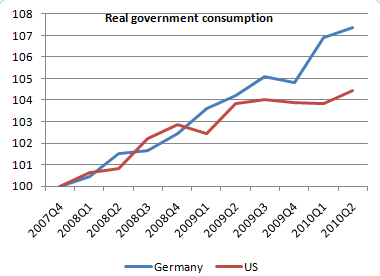
If ever there was a lame post - the one excerpted above is one. (click here to go to it directly) The problem is that this is a keynesian theorist who thinks that connecting imaginary lines together somehow translates to reality. Then apparently he has to attempt to defend his badly conceived line connecting. I guess it makes him feel better about himself. Stimulus clearly has failed, and so, by the way, has government hiring. What happened to all those census jobs? If ever there was a hair-brained scheme to demonstrate employment - census hiring was it.
What I wish would fail is the capability for guy's like Krugman and his ilk to get face time in front of the media. First, the NYTimes pushed that idiot simpleton, actor, writer and economist, Ben Stein on us like he actually knew what was going on and then they push this crap...they definately need new editors. More than likely they need new stock holders, having the Fed minions as you major share holders and benefactors has been known to color the media agenda. To see that in action all you needed to do was watch the sugar plum fairies dancing around and partying like it was 1999 on CNBS today.
Sunday, September 12, 2010
9/11 another look...
When the people fear the government, there is tyranny. When the government fears the people, there is liberty. - Thomas Jefferson
Subscribe to:
Posts (Atom)


