Thursday, March 7, 2013

Inside the emotions right now...

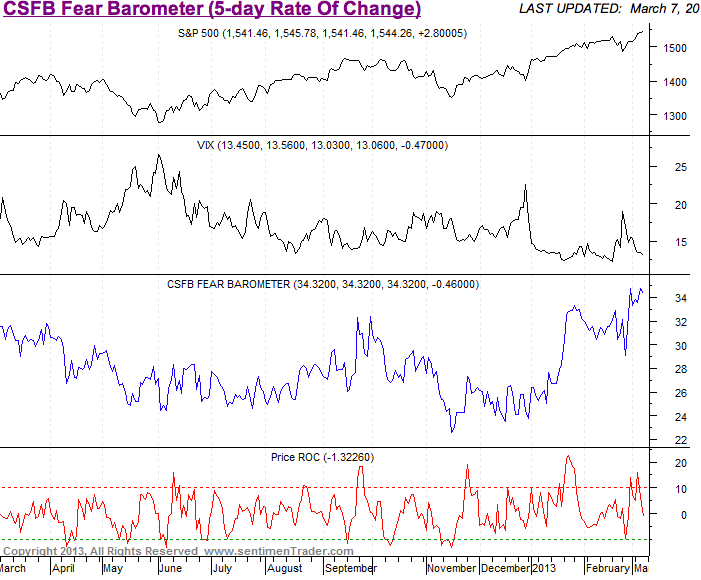
As I indicated early in the week, 80% of participants thought that this week would close up - they usually turn out to be wrong and though most are thinking an up close for the week is in the bag…if pattern holds true that may still not be the case. In addition we had two cycle top dates this occurring week and ADP is often disinformation with regard to the actual jobs report. It is almost an irony how in effect distracting or softening the effect of the actual report - we will see if that curious relationship holds again.  Meanwhile, NASDAQ sentiment closed the day in the 95 percentile and the S&P 500 sentiment closed in the 90 percentile. Below are some more market measures that show context for this weeks aberrant trading. Dow and S&P closing above the bollinger band for 3 days in a row.

Even the most optimistic jobs numbers will likely not be to the markets pleasure...


The Transports...

Cross Currents and Mania...

Wednesday, March 6, 2013

Something wicked this way comes...


EURO
Dollar

a clue…and soon to be coming to the rest of the markets.

The dollar and levitating equities - a major dissagreement...

The likely out come of of this epic dichotomy is not difficult to predict…the above chart is an update to one I posted recently.

Tuesday, March 5, 2013

EVERYONE who knows need not look at where we are...

80+% of traders think the market will close positive this week…they may have been right yesterday and today…but the close of the week is another story entirely

Now that EVERYONE knows…how many more buyers are left

The current hysteria reminds me exactly of the hyperbole being spouted when Apple was 700…and there were not many buyers of Apple left after everyone bought into the hysteria on margin no less.


Monday, March 4, 2013

80+% of participants expect the market to be up this week…

The last time that happened we had one and a half days up and a very hard reversal for the rest of the week. This appears more terminal than the last.


Why are interest rates so low?…don’t ask a central banker…they absolutely will not tell you...

Why are interest rates so low? I could choose to address another question as a parallel. Why are people in the US 26 pounds overweight?

Lets examine how that second question has been and can be answered. "People in the US are 26 pounds overweight because they have a high fat diet and do not exercise sufficiently." That sounds like something I could sell to a broad array of people without much argument. Or how about this: “People in the US are 26 pounds overweight because they work sedentary jobs and drink too much alcohol.” Or, “People in the US are 26 pounds overweight because they eat too much dairy and an increase in the rate of diabetes”.  Or, “People in the US are 26 pounds overweight because their diets are too high in carbohydrates and meat”.  Or, “People in the US are 26 pounds overweight because eat too much”.   Ok…I’ve put out a bunch of reasons each of which have cursory but largely distracting merit in determining why people are overweight in the US. The real reason that people are overweight by 26 pounds is actually totally different…if you would like to understand the answer you can watch this video:


Ben BURNanke is a salesman apparently trying to sell his way into a Nobel Prize for economics he does not understand. His reasons for identifying why interest rates are so low is about as relevant as any of the individual reasons that I wrote above for people in the US being fat…and entirely useless.

Below is a quote of BURNanke’s pre-Nobel Prize marketing tour/victory lap: 
Let's recap. Long-term interest rates are the sum of expected inflation, expected real short-term interest rates, and a term premium. Expected inflation has been low and stable, reflecting central bank mandates and credibility as well as considerable resource slack in the major industrial economies. Real interest rates are expected to remain low, reflecting the weakness of the recovery in advanced economies (and possibly some downgrading of longer-term growth prospects as well). This weakness, all else being equal, dictates that monetary policy must remain accommodative if it is to support the recovery and reduce disinflationary risks. Put another way, at the present time the major industrial economies apparently cannot sustain significantly higher real rates of return; in that respect, central banks--so long as they are meeting their price stability mandates--have little choice but to take actions that keep nominal long-term rates relatively low, as suggested by the similarity in the levels of the rates shown in chart 1. Finally, term premiums are low or negative, reflecting a host of factors, including central bank actions in support of economic recovery. Thus, while the current constellation of long-term rates across many advanced countries has few precedents, it is not puzzling: It follows naturally from the economic circumstances of these countries and the implications of these circumstances for the policies of their central banks. - Ben Benanke
I have never heard such baseless drivel. Lest we forget the charts I posted this weekend, Ben BURNanke is a not just marketing his Nobel Prize candidacy, he is selling something else too: CREDIT. This can clearly be seen in my charts in the previous posts…and apparently he has done a reasonably good job with his unfortunate task. The reality is that the money supply IS credit and he desperately needs people to take on credit just to even enable the settlement of previous credit without default. So, there in the end is a simple reason that governs rates…the amount that someone is willing to charge to issue credit and the rate that a credit worthy borrower is willing to avail himself of it. And there you have it…there are NO other factors. The FED is one of the participants, and as you can see, actively moves the price of credit in all sorts of ridiculous ways.

When you have very little demand for a product what happens? Its price drops. In the case of credit, price equals rate - and there is precious little demand for credit among worthy borrowers, in order to induce them to borrow you must lower the price of the product. This is certainly counter to what should be going on, as the economic risk increases globally, risk of failure, even by worthy borrowers increases. I certainly would not lend money to anyone for 2 or 3 percent in today’s environment. However, if that was my only product offering and there was such little demand, I would be forced to.

There is one more reason that rates are so low and that relates to central banks, governments and institutions who are too large to simply deposit money with a bank and expect its safe keeping and return. If you want to be sure you get your notional deposit back you need it to be in unqualified original currency - in the case of dollars, US Treasury Notes. Many, Many people are concerned with the safe keeping of large amounts of dollars and know that these dollars are NOT safe in the banking system anywhere on deposit and, therefore, must accumulate an array of government debt as a store of their currency. If you have a lot of people willing to buy notes issuing credit to the United States then rates will be very low indeed. This is why i have maintained for a long time that yields on Treasuries will actually not just calculate out to negative yield but in some cases actually go to a negative listed yield.

So, what we essentially have with Ben’s exmplanation is a salesman trying to tell us "people get fat because they get up too late, sleep on their stomachs and don’t play golf”…if you wish to believe him, do so at your own delusion.

Sunday, March 3, 2013

Inducing people to take risk…for what?

Ben BURNanke and Mario DRUGhi want people to be motivated to take risk with their capital and not unrelated they would like them to borrow money as well. As you can see, that has been very successful as far as an initiative is concerned. Results are another thing entirely. The results are that there are people who are so starved for a return that they feel they need more and more leverage (borrowing) to get it and are now setup to be black swan’ed. People are now taking risk and then they are amplifying in hugely. Perhaps the inherent risk to people is now 4x to 8x of what it normally would be. A recent example of what happens when people take this kind of leverage is what happened when people pyramided positions in silver right into the $50 handle. That was followed by an obliteration when we gap opened in the low 40’s and proceeded to the upper 30’s nearly instantaneously.

One of the things with leverage is that you can not exactly tell how it will wind and unwind. Unwinding of leverage can happen via a rise in asset prices and closing of short positions or a fall in assets and a closing of long positions. In either case, leverage is very likely to be visible in patterns such as broadening patterns and wedges. The volatility foot print of our markets is an exact leveraged one…the house of cards is only needing a little breeze to start and a mosquito to arrive.

Saturday, March 2, 2013

Where is all Mr. BURNanke’s money hiding?...

This chart is showing that people have been borrowing more and more money but generating less and less return with it. It is also showing that, predominantly, borrowings used for trading have gone into long positions without dramatic increases in short interest. Additionally, the balances in trading accounts has setup a bear flag and overall has already started turning down. Short interest has setup a continuation flag that looks like it will breakout soon.

According to officials, what you see before you is just what the doctor ordered: Greater risk taking, lower reward and black swan susceptible deleveraging just a sneeze away. Cough, cough..

Interestingly, 82% of investors think March will be up and 60% think next week will be up...I am guessing they are at 120% margin...
Click on chart to see in more detail…

as a note: I have upto-date short interest numbers and margin numbers as of Jan and Feb…most of the NYSE margin charts are still showing December data.

Friday, March 1, 2013

High Yields telling a different story...

The S&P500 has closed up for 9 out of the last 10 weeks - a herculean task. Today Apple Computer was down $11.00+ and the NASDAQ 100 was on up smartly. Whats up with the push? Well, Treasuries have played out exactly as expected in my previous posts and the dollar too…yet equities think both no longer matter. A little closer to equities, High Yield Corporate Bonds, were not too thrilled today and appear to be continuing to setup a solid head and shoulders pattern…hmmm.

Its clear people like beating up on J.C. Penny…but its bigger than them

It clear that people enjoy the Ichan versus Ackman saga…and for the record I think Ichan is playing a more dangerous game than Ackman. Trading done in contempt always results in disasters that pale compared to what one may gain at some point. However, there is much more competition than the J.C. Penny Ichan/Acman story. Its about time that people start realizing that while the has to be an execution problem at Penny, there is a bigger one at U.S. Penny - a totally tapped out, weak, tired and creditless consumer who does not trust the economy or the government and does not want to buy more than he needs from Walmart, Target, J.C. Penny, Sears or Amazon for that matter. Its really quite hard for me to imagine that Ben BURNanke actually thought that his leveraging of risk assets would accomplish anything but increasing wealth for bankers and the already wealthy and some illusionary balance sheet improvement for banks or statistical data upon which he likes to contrive his support of his conflicts of interest for his Fed stakeholder banks. And that again blows me away, how is it legal that a bank can be a shareholder of the Fed? That just seems wrong, wrong, wrong…but it is always ignored and certainly protects the banks agendas as opposed to the J.C. Penny shopper’s agenda.

Thursday, February 28, 2013

Sequestration…what’s that? The media prefers the Fiscal Cliff...

I am not sure, but I AM certain, (???) that the media has a preference for fiscal cliffs as opposed to sequestrations. The funny thing is the sequestration issue in a way is much more significant than the fiscal cliff issue in December…BUT have you heard much about it anyway, anywhere or anyhow? Essentially, sequestration has been sequestered, while fiscal cliffs get catapulted from the smallest recesses of the media centrifuge. I wonder why that is? Could it possibly be because of collaboration between media and government or media and politicians to promote only contentious morphisms that have the capability to embolden some while trampling others? The media has clearly blacked out the sequestration for some reason…perhaps that is because neither party has an advantage to gain or a solution to offer or agree on.

In any case, I have heard next to nothing in CNBC (even though I don’t really like to watch them) other than their ridiculous DOW breakout party. Ohh, and indicentally, has anyone noticed that their parties always come near major tops? …and their mortuary sessions near cataclysmic bottoms?

Well here we are ladies and gentlemen…the sequestration is upon us but the media is not there and its about time to ask why they missed it? Especially when the market is about to fall off a cliff…could not that be a fiscal cliff? CNBC will be right on it…don't worry.

Treasury Breakout…on highest volume since 2004

Lets be realistic, not only are central bank balance sheets in utter disarray but banks in general are in greater disarray than ever before. Price manipulation takes on many forms, if you happen to be one of the rare market participants that is able push around a price in one market to offset losses in another…then there is little chance you will not do it. However, just because you can do that does not change the nature of the margin call. Attempting to create gains in one asset to grant you equity to hold another is still a margin call in my book. And margin calls, usually end up with losses - FOR EVERYONE. Bad trade management and complacency are the death nail of any one holding or trading assets. What this treasury chart says, is that though the market seems complacent…someone knows that something is about to rip heads off. When central banks sell because they will be forced to disclose losses as they get too large to obfuscate - its not going to be a pretty thing…hence the very very real possibility that risk markets could end up in a total freefall…each central bank and institution trying to jump in front of the other to preempt greater losses and unwind their assorted manipulations.

Wednesday, February 27, 2013

Central Banks on the verge of a margin call...

Lets face it, if you can print money you can’t get a margin call…right? WRONG. The central banking cartel have expanded their tool sets dramatically to now include the operation of huge hedge funds. These hedge funds are investing in many of the same assets that legitimate hedge funds invest in. What’s more, they are not disclosing GARGANTUAN LOSSES.

For example, the Israel Central bank has openly acknowledged that it has invested a significant sum directly in global equities…not to mention the Swiss Central Bank, which has 12% or more of its entire 800 billion invested in equities - that is roughly a 96 billion CHF equity portfolio…these are NOT safe assets or short-term government debts. Additionally, we know the ECB (European Central Bank) is sitting on billions of losses in Greek bonds, all marked as par and showing profits…The FED has bought lots of assets of dubious quality - Red Roof Inn bonds anyone? These SAFE central banks are operating risky portfolios/hedgefunds.

Not to focus just on equities, central banks are investing heavily in gold and other pseudo currency securities aggressively attempting to manipulate each other’s currencies. The reality of these machinations is that the least worst of these bad portfolios is the Fed’s due to the fact that they have issued less currency relative to the other central banks in order to generate buying power and manipulate asset prices.

The fact is that many of these central banks are buying securities on the open market and ARE sustaining huge losses that are NOT disclosed. Those losses and the artificial leveraging are manifesting themselves in our markets where relationships have been breaking down for sometime now. The huge and ever increasing amount of central bank malfeasance going on outside the US has made the dollar’s reserve status look more desirable than ever and its shortage greater than ever - hence the huge divergence between the dollar and various assets and strength against nearly all currencies.

This continuous structural demand for dollars by central banks is furthering their own financial stress. The Swiss Central Bank does not want to buy dollars - they MUST. Its all part of the impending margin call. All we need is a shock to set off a chain reaction of these “Central Bank Hedgefunds” into a panic.

The beauty of being a central bank is that you are essentially above the law and full disclosure. Gold, for example, has dropped by nearly 25% and central banks were and have been purchasing more gold than ever as we rose to the highs and have been dropping. The reason that we will continue to have dollar strength is that central banks can not continue to sustain and obfuscate losses. The Fed is not being forthright either, they have bought an abundance of assets in which they are sustaining huge losses. Moreover, I am not at all sure that any of these institutions have really thought about what will be required for them to exit given that they seem to think that they can simply make side deals with each other to make things look copacetic…the persistent strength of the dollar, however, is a serious problem and a very ominous sign for them and representative that things are not going well. As long as virtually unmanaged losses continue to build on central bank balance sheets, there will be greater and greater demand for the dollar and greater and greater losses and stresses for them to deal with…in turn exacerbating the cycle till we sustain a parabolic result.

It is absolutely ridiculous to believe Mr. Bernanke or any central bank chairman talking about the strength of their balance sheets when they are all tied together and grossly short of buying power. The patterns in the dollar currently, the EURO and the risk asset markets are all demonstrating internal stress. Abundant megaphone and broadening patterns are symbols of unwinding of leverage and stressed positions…from the looks of things we are about to complete yet another broadening pattern much to the dismay of our central bank chairmen.

Central Bank buying power is limited by the capabilities of its economy and its ability to be viewed as a champion of its causes. Balance sheet losses are a very bad way to convey championing your economies causes and will lead to forced unwinding of positions when they can no longer be obfuscated.

When history judges, I believe that the malfeasance and deception of the Central Banking cartel will be judged with dismay and disgust.
Apparently, even a central banker is not very interested in banks...
 
© 2009 m3, ltd. All rights reserved.