That’s all that’s left of what our financial system is based on. Over belief in central bankers to overcome everything and anything. This is most definitely NOT the case, as evidenced by the ECB and the FED’s failure in Europe.
Situation Normal all F**ed Up…
Cyprus was a slow motion train wreck facilitated by the FED and ECB encouragement for EURO banks and institutions to take advantage of central bank liquidity and to take risk buying very risky bonds. Withdrawals from Cyprus banks hit critical mass and the ECB, given a litany of new and larger calamities that are coming up fast, decided it could no longer support its own charade, whereby lots and lots of economies pretend to be solvent because ECB says they are and find out they are not when ECB says that they are not.
During this time, it seems pretty clear that just about any asset other than a European bank deposit is a better risk - given that you can easily lose 70 to 90% in a bank. This apparently has had the effect of levitating the US equity markets despite significant declines in most every commodity market. It also, supported the dollar which is certainly counter the equity rally in the US. However, what is happening now is the collapse of other much large banks than the Cyprus institutions…the grace period offered by the symbolism of the Cyprus adventure will not be afforded for a bank in the top 100 as per assets. This is what is happening in Italy right now and when the bank run starts there in earnest, which seems imminent, there will not be sufficient sovereign capital to back up the bank and there will be a very real risk of a cascade of bank insolvencies and sovereign defaults. This will not result in the outcome of people being afforded the luxury of picking up bonds and other assets in the US (the least of the dirty shirts) or time to make adjustments. Instead, it will result in assets being liquidated here and everywhere with great gravitas as the over leverage, over belief and over optimism explodes into the one thing people are forgetting - over risk. Freefallin, Freefallin should not be confused with buying as its dip’in. Believe it or not…
When you find out that your financial institution has no money, it will not happen in such a way that you have time to go calmly to the bank and request a withdrawal…it will happen on a holiday weekend, when you have no real alternatives and insufficient time to get in front of it…the Fed and ECB have setup all the elements required to accomplish the same as this but in a far bigger fashion and there will not likely be time for all the margined up investors and buy the dippers to make the smooth transition they may be imagining.
Deutsche Bank's Joe LaVorgna thinks GDP may have grown by as much as 4 percent in Q1. - April Fools - but its really true, he believes that.
BURNanke is looking a new job that he’s qulaified for…sanitation engineering possibly? But that’s true too…damned shame I can’t come up with some good April Fool’s - so here’s some pictures of one:
The Dow Jones and Standard & Poor’s 500 indexes reached record highs on Thursday, having completely erased the losses since the stock market’s last peak, in 2007. But instead of cheering, we should be very afraid.
Over the last 13 years, the stock market has twice crashed and touched off a recession: American households lost $5 trillion in the 2000 dot-com bust and more than $7 trillion in the 2007 housing crash. Sooner or later — within a few years, I predict — this latest Wall Street bubble, inflated by an egregious flood of phony money from the Federal Reserve rather than real economic gains, will explode, too.
Since the S.&P. 500 first reached its current level, in March 2000, the mad money printers at the Federal Reserve have expanded their balance sheet sixfold (to $3.2 trillion from $500 billion). Yet during that stretch, economic output has grown by an average of 1.7 percent a year (the slowest since the Civil War); real business investment has crawled forward at only 0.8 percent per year; and the payroll job count has crept up at a negligible 0.1 percent annually. Real median family income growth has dropped 8 percent, and the number of full-time middle class jobs, 6 percent. The real net worth of the “bottom” 90 percent has dropped by one-fourth. The number of food stamp and disability aid recipients has more than doubled, to 59 million, about one in five Americans.
So the Main Street economy is failing while Washington is piling a soaring debt burden on our descendants, unable to rein in either the warfare state or the welfare state or raise the taxes needed to pay the nation’s bills. By default, the Fed has resorted to a radical, uncharted spree of money printing. But the flood of liquidity, instead of spurring banks to lend and corporations to spend, has stayed trapped in the canyons of Wall Street, where it is inflating yet another unsustainable bubble.
When it bursts, there will be no new round of bailouts like the ones the banks got in 2008. Instead, America will descend into an era of zero-sum austerity and virulent political conflict, extinguishing even today’s feeble remnants of economic growth.
THIS dyspeptic prospect results from the fact that we are now state-wrecked. With only brief interruptions, we’ve had eight decades of increasingly frenetic fiscal and monetary policy activism intended to counter the cyclical bumps and grinds of the free market and its purported tendency to underproduce jobs and economic output. The toll has been heavy.
As the federal government and its central-bank sidekick, the Fed, have groped for one goal after another — smoothing out the business cycle, minimizing inflation and unemployment at the same time, rolling out a giant social insurance blanket, promoting homeownership, subsidizing medical care, propping up old industries (agriculture, automobiles) and fostering new ones (“clean” energy, biotechnology) and, above all, bailing out Wall Street — they have now succumbed to overload, overreach and outside capture by powerful interests. The modern Keynesian state is broke, paralyzed and mired in empty ritual incantations about stimulating “demand,” even as it fosters a mutant crony capitalism that periodically lavishes the top 1 percent with speculative windfalls.
The culprits are bipartisan, though you’d never guess that from the blather that passes for political discourse these days. The state-wreck originated in 1933, when Franklin D. Roosevelt opted for fiat money (currency not fundamentally backed by gold), economic nationalism and capitalist cartels in agriculture and industry.
Under the exigencies of World War II (which did far more to end the Depression than the New Deal did), the state got hugely bloated, but remarkably, the bloat was put into brief remission during a midcentury golden era of sound money and fiscal rectitude with Dwight D. Eisenhower in the White House and William McChesney Martin Jr. at the Fed.
Then came Lyndon B. Johnson’s “guns and butter” excesses, which were intensified over one perfidious weekend at Camp David, Md., in 1971, when Richard M. Nixon essentially defaulted on the nation’s debt obligations by finally ending the convertibility of gold to the dollar. That one act — arguably a sin graver than Watergate — meant the end of national financial discipline and the start of a four-decade spree during which we have lived high on the hog, running a cumulative $8 trillion current-account deficit. In effect, America underwent an internal leveraged buyout, raising our ratio of total debt (public and private) to economic output to about 3.6 from its historic level of about 1.6. Hence the $30 trillion in excess debt (more than half the total debt, $56 trillion) that hangs over the American economy today.
This explosion of borrowing was the stepchild of the floating-money contraption deposited in the Nixon White House by Milton Friedman, the supposed hero of free-market economics who in fact sowed the seed for a never-ending expansion of the money supply. The Fed, which celebrates its centenary this year, fueled a roaring inflation in goods and commodities during the 1970s that was brought under control only by the iron resolve of Paul A. Volcker, its chairman from 1979 to 1987.
Under his successor, the lapsed hero Alan Greenspan, the Fed dropped Friedman’s penurious rules for monetary expansion, keeping interest rates too low for too long and flooding Wall Street with freshly minted cash. What became known as the “Greenspan put” — the implicit assumption that the Fed would step in if asset prices dropped, as they did after the 1987 stock-market crash — was reinforced by the Fed’s unforgivable 1998 bailout of the hedge fund Long-Term Capital Management.
That Mr. Greenspan’s loose monetary policies didn’t set off inflation was only because domestic prices for goods and labor were crushed by the huge flow of imports from the factories of Asia. By offshoring America’s tradable-goods sector, the Fed kept the Consumer Price Index contained, but also permitted the excess liquidity to foster a roaring inflation in financial assets. Mr. Greenspan’s pandering incited the greatest equity boom in history, with the stock market rising fivefold between the 1987 crash and the 2000 dot-com bust.
Soon Americans stopped saving and consumed everything they earned and all they could borrow. The Asians, burned by their own 1997 financial crisis, were happy to oblige us. They — China and Japan above all — accumulated huge dollar reserves, transforming their central banks into a string of monetary roach motels where sovereign debt goes in but never comes out. We’ve been living on borrowed time — and spending Asians’ borrowed dimes.
This dynamic reinforced the Reaganite shibboleth that “deficits don’t matter” and the fact that nearly $5 trillion of the nation’s $12 trillion in “publicly held” debt is actually sequestered in the vaults of central banks. The destruction of fiscal rectitude under Ronald Reagan — one reason I resigned as his budget chief in 1985 — was the greatest of his many dramatic acts. It created a template for the Republicans’ utter abandonment of the balanced-budget policies of Calvin Coolidge and allowed George W. Bush to dive into the deep end, bankrupting the nation through two misbegotten and unfinanced wars, a giant expansion of Medicare and a tax-cutting spree for the wealthy that turned K Street lobbyists into the de facto office of national tax policy. In effect, the G.O.P. embraced Keynesianism — for the wealthy.
The explosion of the housing market, abetted by phony credit ratings, securitization shenanigans and willful malpractice by mortgage lenders, originators and brokers, has been well documented. Less known is the balance-sheet explosion among the top 10 Wall Street banks during the eight years ending in 2008. Though their tiny sliver of equity capital hardly grew, their dependence on unstable “hot money” soared as the regulatory harness the Glass-Steagall Act had wisely imposed during the Depression was totally dismantled.
Within weeks of the Lehman Brothers bankruptcy in September 2008, Washington, with Wall Street’s gun to its head, propped up the remnants of this financial mess in a panic-stricken melee of bailouts and money-printing that is the single most shameful chapter in American financial history.
There was never a remote threat of a Great Depression 2.0 or of a financial nuclear winter, contrary to the dire warnings of Ben S. Bernanke, the Fed chairman since 2006. The Great Fear — manifested by the stock market plunge when the House voted down the TARP bailout before caving and passing it — was purely another Wall Street concoction. Had President Bush and his Goldman Sachs adviser (a k a Treasury Secretary) Henry M. Paulson Jr. stood firm, the crisis would have burned out on its own and meted out to speculators the losses they so richly deserved. The Main Street banking system was never in serious jeopardy, ATMs were not going dark and the money market industry was not imploding.
Instead, the White House, Congress and the Fed, under Mr. Bush and then President Obama, made a series of desperate, reckless maneuvers that were not only unnecessary but ruinous. The auto bailouts, for example, simply shifted jobs around — particularly to the aging, electorally vital Rust Belt — rather than saving them. The “green energy” component of Mr. Obama’s stimulus was mainly a nearly $1 billion giveaway to crony capitalists, like the venture capitalist John Doerr and the self-proclaimed outer-space visionary Elon Musk, to make new toys for the affluent.
Less than 5 percent of the $800 billion Obama stimulus went to the truly needy for food stamps, earned-income tax credits and other forms of poverty relief. The preponderant share ended up in money dumps to state and local governments, pork-barrel infrastructure projects, business tax loopholes and indiscriminate middle-class tax cuts. The Democratic Keynesians, as intellectually bankrupt as their Republican counterparts (though less hypocritical), had no solution beyond handing out borrowed money to consumers, hoping they would buy a lawn mower, a flat-screen TV or, at least, dinner at Red Lobster.
But even Mr. Obama’s hopelessly glib policies could not match the audacity of the Fed, which dropped interest rates to zero and then digitally printed new money at the astounding rate of $600 million per hour. Fast-money speculators have been “purchasing” giant piles of Treasury debt and mortgage-backed securities, almost entirely by using short-term overnight money borrowed at essentially zero cost, thanks to the Fed. Uncle Ben has lined their pockets.
If and when the Fed — which now promises to get unemployment below 6.5 percent as long as inflation doesn’t exceed 2.5 percent — even hints at shrinking its balance sheet, it will elicit a tidal wave of sell orders, because even a modest drop in bond prices would destroy the arbitrageurs’ profits. Notwithstanding Mr. Bernanke’s assurances about eventually, gradually making a smooth exit, the Fed is domiciled in a monetary prison of its own making.
While the Fed fiddles, Congress burns. Self-titled fiscal hawks like Paul D. Ryan, the chairman of the House Budget Committee, are terrified of telling the truth: that the 10-year deficit is actually $15 trillion to $20 trillion, far larger than the Congressional Budget Office’s estimate of $7 trillion. Its latest forecast, which imagines 16.4 million new jobs in the next decade, compared with only 2.5 million in the last 10 years, is only one of the more extreme examples of Washington’s delusions.
Even a supposedly “bold” measure — linking the cost-of-living adjustment for Social Security payments to a different kind of inflation index — would save just $200 billion over a decade, amounting to hardly 1 percent of the problem. Mr. Ryan’s latest budget shamelessly gives Social Security and Medicare a 10-year pass, notwithstanding that a fair portion of their nearly $19 trillion cost over that decade would go to the affluent elderly. At the same time, his proposal for draconian 30 percent cuts over a decade on the $7 trillion safety net — Medicaid, food stamps and the earned-income tax credit — is another front in the G.O.P.’s war against the 99 percent.
Without any changes, over the next decade or so, the gross federal debt, now nearly $17 trillion, will hurtle toward $30 trillion and soar to 150 percent of gross domestic product from around 105 percent today. Since our constitutional stasis rules out any prospect of a “grand bargain,” the nation’s fiscal collapse will play out incrementally, like a Greek/Cypriot tragedy, in carefully choreographed crises over debt ceilings, continuing resolutions and temporary budgetary patches.
The future is bleak. The greatest construction boom in recorded history — China’s money dump on infrastructure over the last 15 years — is slowing. Brazil, India, Russia, Turkey, South Africa and all the other growing middle-income nations cannot make up for the shortfall in demand. The American machinery of monetary and fiscal stimulus has reached its limits. Japan is sinking into old-age bankruptcy and Europe into welfare-state senescence. The new rulers enthroned in Beijing last year know that after two decades of wild lending, speculation and building, even they will face a day of reckoning, too.
THE state-wreck ahead is a far cry from the “Great Moderation” proclaimed in 2004 by Mr. Bernanke, who predicted that prosperity would be everlasting because the Fed had tamed the business cycle and, as late as March 2007, testified that the impact of the subprime meltdown “seems likely to be contained.” Instead of moderation, what’s at hand is a Great Deformation, arising from a rogue central bank that has abetted the Wall Street casino, crucified savers on a cross of zero interest rates and fueled a global commodity bubble that erodes Main Street living standards through rising food and energy prices — a form of inflation that the Fed fecklessly disregards in calculating inflation.
These policies have brought America to an end-stage metastasis. The way out would be so radical it can’t happen. It would necessitate a sweeping divorce of the state and the market economy. It would require a renunciation of crony capitalism and its first cousin: Keynesian economics in all its forms. The state would need to get out of the business of imperial hubris, economic uplift and social insurance and shift its focus to managing and financing an effective, affordable, means-tested safety net.
All this would require drastic deflation of the realm of politics and the abolition of incumbency itself, because the machinery of the state and the machinery of re-election have become conterminous. Prying them apart would entail sweeping constitutional surgery: amendments to give the president and members of Congress a single six-year term, with no re-election; providing 100 percent public financing for candidates; strictly limiting the duration of campaigns (say, to eight weeks); and prohibiting, for life, lobbying by anyone who has been on a legislative or executive payroll. It would also require overturning Citizens United and mandating that Congress pass a balanced budget, or face an automatic sequester of spending.
It would also require purging the corrosive financialization that has turned the economy into a giant casino since the 1970s. This would mean putting the great Wall Street banks out in the cold to compete as at-risk free enterprises, without access to cheap Fed loans or deposit insurance. Banks would be able to take deposits and make commercial loans, but be banned from trading, underwriting and money management in all its forms.
It would require, finally, benching the Fed’s central planners, and restoring the central bank’s original mission: to provide liquidity in times of crisis but never to buy government debt or try to micromanage the economy. Getting the Fed out of the financial markets is the only way to put free markets and genuine wealth creation back into capitalism.
That, of course, will never happen because there are trillions of dollars of assets, from Shanghai skyscrapers to Fortune 1000 stocks to the latest housing market “recovery,” artificially propped up by the Fed’s interest-rate repression. The United States is broke — fiscally, morally, intellectually — and the Fed has incited a global currency war (Japan just signed up, the Brazilians and Chinese are angry, and the German-dominated euro zone is crumbling) that will soon overwhelm it. When the latest bubble pops, there will be nothing to stop the collapse. If this sounds like advice to get out of the markets and hide out in cash, it is.
David A. Stockman is a former Republican congressman from Michigan, President Ronald Reagan’s budget director from 1981 to 1985 and theauthor, most recently, of “The Great Deformation: The Corruption of Capitalism in America.”
"FDIC has taken care of every single person effected by the financial crisis" according to BURNanke…”not one has lost a single dollar”…is that an answer to the question of whether it possible to have haircuts on US accounts for US account holders on US shores? Shiela Bair apparently is smart enough to have vacated FDIC before she was to be asked that question under similar official scruitiny.
Kyriacos Loizides, a 53 year old businessman, said: "Next week there will be huge demonstrations [in Cyprus]. I think there will be violence and killings. People will take revenge against the people who created this scandal, this tragedy.” And we have not had anyother EU bank blow ups yet…or US - all of which is waiting in the wings.
The harmonics are startling and ont he DOW show us just a few points from the nirvana of a perfect hit at 14585…(chart to come)…meanwhile here is the S&P500...
This is a very large chart click on it for detail…for highest resolution click this link
This is a very large chart click on it for detail…for highest resolution click this link
Guidelines for expanding broadening triangles indicate that each wave needs to retrace atleast 100% of the previous wave and optimally between 105% and 125% but not more than 150% +/- a few percent on all measures. In terms of the triangle as it progresses, each move in the triangle will be a greater number of points but a lesser amount of percent of each prior wave, and therefore, limits the current wave to a maximum of the pervious wave’s retracement percent but usually prefers a fibo relationship percentagewise.
How interesting it is that what we don’t see, don’t hear and are not reminded of seems to not matter. Fukushima, Libya, Egypt, Iraq, Syria, FED balance sheet (hedge fund), Greece, Ireland, Portugal, Belgium, Luxembourg, Slovenia, Hungary, Bolivia, Citibank, JP Morgan, Goldman Sachs, Central Banks, IMF, Water, Plastic, Obesity, Unemployment…
That’s a list for sure, but one that politicians and bureaucrats have attempted with serious conviction to obfuscate. We hear nothing really after spending 7 trillion in IRAQ and leaving the country in a bigger state of upheaval than before we started. We hear nothing about Libya, so, yes - “it must be fine”. We hear nothing about Egypt, so there is a beautiful blossoming American approved democracy budding there and the Arab Spring is yielding flowers and fruits for everyone. Fukushima’s half-life is over 300,000 years, yet its now safe to eat fish from the oceans, move back to the provinces and play on the streets after just a few years. JP Morgan, though recently in the news, is now all fine just because we made certain that we nipped their indiscretions in the bud and talked them down in a public hearing - now its back to business as usual for regulators and JPM - faulty accounting, books and marks and all. Nothing to worry about there.
The FED is the only asset buyer in history that can buy Hotel Debt, Mortgages, US bonds and other bonds (and most likely Equities in their unnamed and unmarked accounts) and NEVER lose money…though they are clearly teaching JPM required mismarking and book making skills…but since it seems like it essentially adds up - why even think about it - the FED will hold till maturity even if that means S&P500 shares bought at 1560 take 40 years to mature - skipping over any price drops…Citibank, Goldman Sachs (among others) can now pay dividends and do share buybacks…nothing to worry about because everything has to be fine for them to be allowed to do such a thing. Greece, where’s that? Scuttlebut has it that, as arranged by Angela Merkel and EU, Greece was taken over by Cyprus…Greece is now just fine and Cyprus will be fine too if we all can only stop thinking about it for a little while. Just get the yields down on bonds from Italy, Greece, Ireland, Portugal, Spain and no one will be able to even find those countries on a map. Unemployment, dropping like a rock thanks to the FED mandate to lower the size of the national workforce rather than to increase the number of jobs. Nothing to worry about - not even worth a newspaper mention. Libya, was a much better place to live apparently than nearly any European country and probably the US too…however, now thanks to our NATO (I mean American) little intervention we need’nt worry about it - everything is just fine…realize that decending into chaos is no issue unless it makes the news…we did our job spending billions to bring the relative instability and calm there and call it stabilization, democracy and order. Capitalism and Freemarkets why do we have to worry about those if intervention and Central Banking work just fine to replace individuals and markets.
Right now the headlines, political rhetoric are absent the real issues and the realities are absent the politicians, news or awareness. Everything is FINE…the S&P 500 is 1570! and its Easter!
Today we had a condition that has only occured three times since 2007…VIX Up, Dollar Up, Bonds Up with markets making recent new highs…see chart below for these occurences:
click chart to see a more detailed image:
VIX UP = Market Rally
Bonds Up = Market Rally
Dollar Up = Market Rally
Total European Banking System Failure = Market Up and near highs
Currency Controls = party time for Ben BURNanke
ECB Officials dazed and confused = Risk On
Margin Debt increases for Feb = Margin Debt increase in March
I wanted to discuss the status of the European dilemma...there is a huge dichotomy going on and its is highly dischordant. We have a crazy situation where, the ECB wants Cyprus to play by the rules, yet ECB and EU are making them up as they go along. Firstly, we must ask some basic questions.
I am going to try to answer them as best as possible...I think some graphics will be necessary...
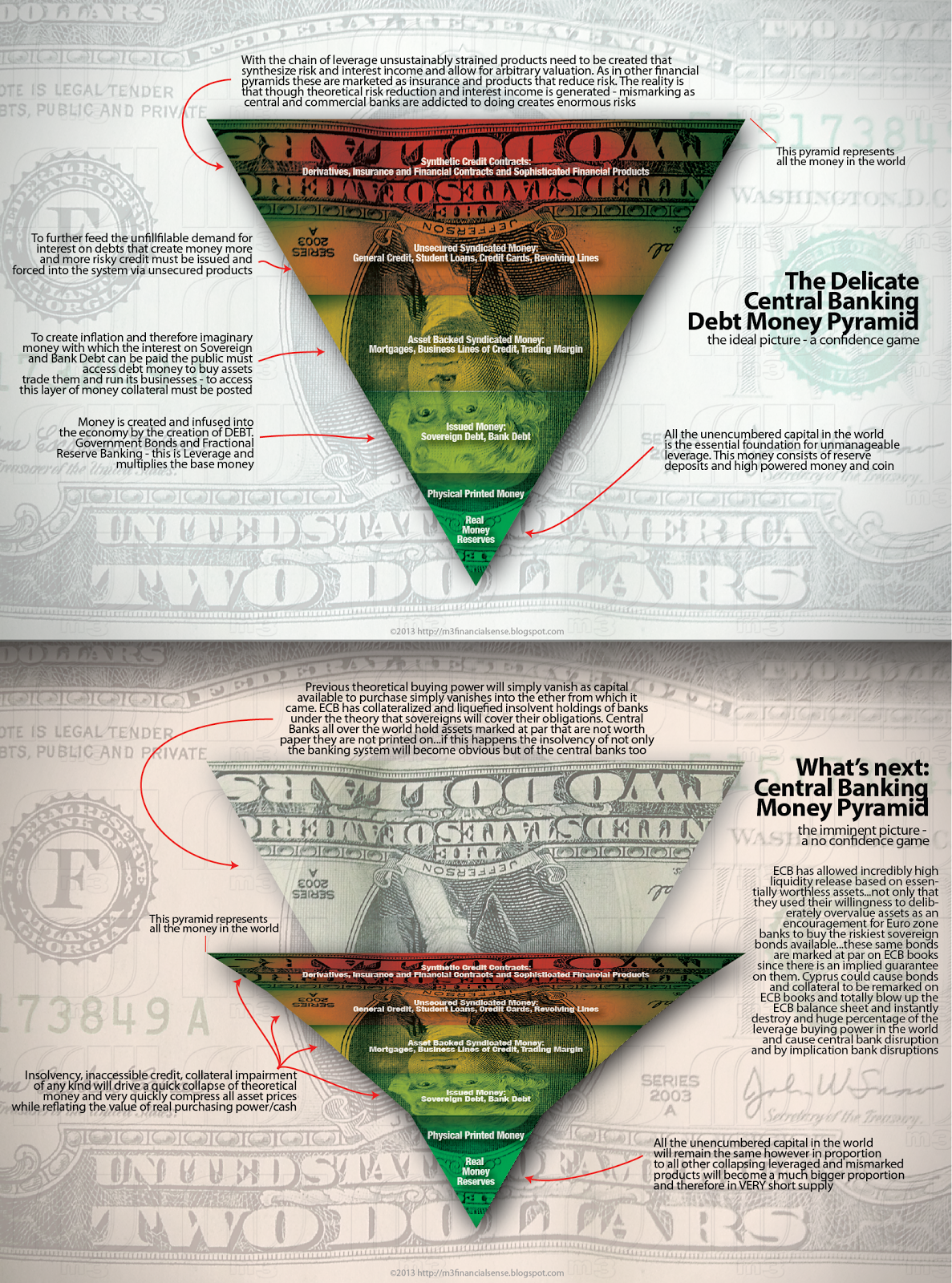
Above you can see the essential structure of the central bank credit driven monetary system...at the very bottom of the pyramid is the real unencumbered cash...the rest of the cash system is credit money with its inherent implied obligations attached. What seems to be partially happening, as evidenced with the huge rise in bitcoin, is that people are redefining their concepts of what they think money actually is. Perhaps, stocks and commodities will begin to replace fiat tender for a time...but probably not for long. Ultimately, not very far away, they as well as any other asset, will have to be be sold as sources to raise fiat money as the great credit money pyramid collapses.
As you can see above, I show no actual assets on this pyramid. That is because almost every asset in the world is collateral for some sort of debt. The fact is that though you may think you own your home when it is paid off, the government has already pledged it in some from or another in order to create new credit money.
Now to the questions:
The ECB is the defacto regulator for all EURO banks. Cyprus banks have been insolvent for years, yet its only NOW that we find out that they were allowed to store nearly all of their reserves in Greek bonds...how could this be possible?
Since Greek (among others) bonds imploded years ago, just who is the bigger problem? the regulator who allowed concentrated investments in them? The regulator that allowed them to be held on books, used as collateral and itself leveraged with the pretense of solvency?
Why did the ECB attempt to fuel demand for high risk sovereign bonds at any cost…Cyprus being one of them? Its a rather interesting picture. I can not imagine as a defacto regulator that you would allow a bank to safely park its reserves in high risk investments but that’s exactly what ECB has done and not just with Cyprus, with Italy, Spain, France and just about anyone else they could tempt. The temptation was multiple fold…high releases on collateral and high returns in terms of yield on bonds. The idea seems nice enough, except that the bonds of Greece have not been worth anything for a long time…which is why its peculiar that ECB decided that NOW was the time to stop granting Cyprus collateral release on them. It’s clear something else must be going on here…
Obviously, any astute foreign nationals with money in a Cyprus bank must have been withdrawing large amounts of money recently in order to create the present condition that the ECB finds so contradictory and repugnant and that it had to be handled in the most ridiculous and inept way they have chosen. What else has really changed in the last months that should change the ECB's policy so drastically? Several years ago Greek bonds were actually worth less than recently and ECB did not force Cyprus to steal money from its depositors. They obviously have done so now because the EURO system is riddled with similar problems and the ECB is for all intents and purposes, insolvent.
We need to remember that ECB is holding vast amounts of worthless bonds as collateral, not just Greek, but Spanish and Italian, Latvian and Belgian etc…they have sustained the pretense of things improving by encouraging banks to take tremendous risks and purchase relatively high yielding bonds with the benefit of high collateralization rates with ECB…when sovereign guarantees are meaningless ECB will be forced to mark them properly rather than magically.
Why is ECB trying so hard to resist the Greek style "close your eyes and do anything" approach and say anything PR campaign?
ECB clearly has fear of much bigger problems and needs to manage its behaviour now in such a way as to not have to roll over for the other 15 insolvent EURO nations when they can no longer suppress them. Spain and Italy make Cyprus look like an ant on an ant hill compared to the giant Dung Beetles waiting to emerge from their burrows, since a Cypriot national default would render the ECB immediately insolvent and require all plus some of their reserves.
Just how much collateral is the ECB holding on its books at par that is really @ 0?
More than I can count for sure…I would like to know this answer specifically however…
Just what is the theft, I mean haircut, ahemm - levy and what does it mean? Who does it really effect? How long are funds impaired?
The funny thing about this haircut issue is that its really not as advertised. As I get ready to post this, a 40% haircut has been agreed to and that is exceeding even my worst expectations. But if that was the end of the story that would be bad enough, but it is not.
If you have 1 million Euros in Laiki Bank, 100,000 will be paid to an account at a supposedly solvent bank. The remaining 900,000 will be held in a “bad” bank…360,000 will be deducted leaving 540,000 which you will not be able to access till the bank is liquidated…at which point you will likely find out that you will get 10 to 30% of the remaining amount - IN FIVE YEARS!!!
So, the advertised 40% haircut is likely really only going to give you 200,000 to 250,000 euros back. If you happen to be an employer in Cyprus, you are not anymore. And while its nice that all the individuals with less than 100,000 in their account will be whole…they likely will be out of a job. Politicians will of course. demonstrate that they saved the voters from loss…and though those voters will be out of a job because the bulge bracket employers are no longer…the Cypriot leaders will blame Germany for that little issue. hmmmm
How is JP Morgan involved?
Though, as far as I can yet see, JP Morgan is not involved with the Cyprus debacle directly. However, they 80 trillion of mismarked securities are a symptom of the the Central Banking system and Banking System run amok. This is the exact problem that has encouraged the top levels on the chart above and which is enabling the ECB and many other central banks and banks to operate as if they are solvent when they are absolutely the opposite. JP Morgan is just the poster boy and the example…ohhh, and by the way, totally insolvent.
Cyprus is so small - does it really matter?
A Cypriot national default would render the ECB immediately insolvent and require all plus some of their reserves…and that matters a great deal if Van RUMPy and BarRUFFo would like to keep their cushy corner offices.
What is the architecture of this problem?
Debt, more debt and when you have a really big problem more debt. When all else fails instead of indirect theft…just do it directly. The end result of all of this will be quite simple, default after default and a contraction in the size of the money system by gargantuan amounts. It is very easy to destroy credit created money and our illustrious leaders have done a great job of it. The only problem, is that when you do so, you destroy lives, productivity and potential aswell. Just as any Cypriot today. And while the markets are celebrating the insantiy to which our financial system has resorted, as if its good news, I suspect they will not be looking at contagious 90% haircuts very favorably in the future.
One thing of note, when Ben BURNanke was hased if American’s would be hit with a similar crisis and haircuts, he neglected to answer the question at all, and instead said that “Since the worst of the economic crisis in 2008, the FDIC has protected every account and not one person has lost a single dollar"…I hope you don’t mind if I read between the lines.
Trichet’s pack of LIES are a great example of what apparently is a contagious problem within the ECB, the EU and the Central Banking Cartel in general. Below is Trichet’s speech welcoming Cyprus into the EURO - apparently approved by Juncker:
The successful entry of Cyprus into the euro area
Speech by Jean-Claude Trichet, President of the ECB Speech at the Conference “Welcoming Cyprus to the euro area” Nicosia, 18 January 2008
Ladies and Gentlemen,
It is a great pleasure for me to attend this conference celebrating your adoption of the euro. Let me first congratulate all parties involved in the successful cash changeover that took place at the beginning of the year. It has been going smoothly. None of this would have been possible without the excellent performance of the Cypriot economy during the convergence process.
1. Cyprus’s economic achievements on the way to the euro [1]
Today’s euro celebrations are the result of the successful macroeconomic policies that the Cypriot authorities have pursued in recent years. Cyprus has made significant progress in both nominal and real convergence, owing to successful policies – namely, well-managed monetary and exchange rate policies combined with a range of structural reforms. In the last decade, HICP inflation in Cyprus has been contained, averaging 2.2% in 2007, with the only exceptions being in 2000 and 2003, when inflation rose mainly because of increases in energy prices as well as VAT harmonisation. Short-term as well as long-term interest rates have followed a declining trend in recent years to levels in line with those of the euro area as a whole. This suggests that market participants have confidence in Cyprus’s macroeconomic and fiscal developments as well as in its monetary and exchange rate policies.
The process of nominal convergence has been accompanied by robust economic growth. Real GDP growth in Cyprus has been well above that in the euro area in recent years. Real output growth has been underpinned by domestic demand, and in particular by strong private consumption and, importantly, by strong fixed capital formation. Cyprus’s GDP per capita (in PPP terms) progressed from around 74% of the 1996 average of the 12 countries which initially joined the euro area to around 84% in 2006: this is a significant improvement, and may it continue that way.
In spite of its remarkable progress towards nominal and real convergence, Cyprus has not experienced major imbalances: price and cost competitiveness developments have been favourable since 2004. The fiscal balance (the deficit-to-GDP ratio) has been improving since 2004 and stood at -1.2% of GDP in 2006. Looking at the financial side, Cyprus is experiencing substantial financial deepening, which has been reflected in robust credit activity. Although this process accompanies and supports economic development, it should be carefully monitored, particularly because it is taking place at a very rapid pace.
Membership of the Exchange Rate Mechanism II (ERM II) was another element in Cyprus’s successful convergence. The pound-euro exchange rate at which Cyprus joined the ERM II in May 2005 remained very stable throughout the period of ERM II participation. The EU Council decided that the central parity should also become the final conversion rate of the pound to the euro.
2. Cooperation between the Central Bank of Cyprus and the ECB
Let me also say that the ECB has established excellent working relations with the Central Bank of Cyprus over the last couple of years. The Governor of the Central Bank of Cyprus has been a member of the General Council of the ECB since May 2004. As from mid-2007, Governor Orphanides attended the meetings of the Governing Council as an observer, and on 1 January 2008 he became an official member of that decision-making body for monetary policy in the euro area.
The ECB and the Central Bank of Cyprus, together with the National Changeover Board, the European Commission and national and international authorities cooperated closely in many ways to prepare the introduction of the euro. The euro information campaigns played a vital role here. The ECB together with the Central Bank of Cyprus made sure that Cypriots became familiar with the euro banknotes and coins.
The information campaigns consisted of an optimal communication mix that drew on the experience of the communication campaign in 2002, when euro cash was introduced in 12 countries, as well as the campaign for Slovenia prior to its joining the euro area in 2007. It included public opinion polls, advertising and direct marketing. Over 900,000 copies of different publications were distributed by the Central Bank of Cyprus - this is more than one copy per Cypriot! The aim was to enable everyone in Cyprus to check their new euro banknotes: every household received euro banknote ‘cards’, the same size as a credit card. They show the three main security features of the €50 and €20 banknotes and how to check them.
As a result of these efforts, today we can celebrate a successful cash changeover. I am sure that the excellent relationship between the Central Bank of Cyprus and the ECB will grow even stronger, now that the central bank is a member of the Eurosystem. Indeed, intimate cooperation between the members of the team, the national central banks of the Eurosystem, and the ECB is the key for the success of the single monetary policy in the euro area.
3. Ensuring the sustainability of convergence as a euro area country
The entry of Cyprus into the euro area implies that the benefits of the Single Market will be further enhanced by the single currency. The euro offers a credible framework for price stability in an environment characterised by the absence of exchange rate uncertainty within the euro area. Cyprus will benefit from the stability-oriented policy of the ECB, which will help anchor inflation expectations. Furthermore, for a small open economy such as Cyprus, the euro adoption provides protection against international financial turmoil, which often has a disproportionate effect on smaller economies.
Now, almost three weeks after the introduction of the new currency, I would like to stress that, in the short term, the conversion of prices into euros should not be taken as an opportunity to make unjustified price rises. This is especially important considering that food and energy prices are already exerting upward pressure on inflation in the euro area as a whole. Against this background, measures taken by the Cypriot government together with retailers, importers and manufacturers in order to avoid such adjustments are commendable.
Looking further ahead, in order to fully reap the advantages of the euro and to ensure sustainable convergence, additional efforts with structural reform should be undertaken and appropriate policies implemented. The Cypriot economy needs to continue on a sustainable and credible path of fiscal consolidation based on structural measures, to improve its fiscal performance by reducing its debt ratios and to comply with the medium-term objective quantified in the convergence programme. In particular, public finances should have sufficient room for manoeuvre in order to better cope with the expected substantial increase in age-related public expenditures. Moreover, wage settlements need to remain moderate, taking into account labour productivity growth, labour market conditions and developments in competitor countries. For example, the indexation mechanism for wages and for some social benefits (cost-of-living allowances) should be reviewed in order to reduce risks associated with inflation inertia and losses in competitiveness. Such measures will not only make Cyprus’s economy more resilient to shocks but also create the best conditions for sustainable economic expansion, employment growth and price stability.
Ladies and gentlemen, let me again congratulate you on your successful adoption of the euro and extend my very, very warm welcome to the new member of the Eurosystem family. Warmest welcome Cyprus!
The good news for Mr. BURNanke (bad for newsletter authors) is that he can finally cancel his subscriptions to Richard Russell, Boom Doom and Gloom, Elliotwave Theorist and a host of others…since he will not be staying on the job past this term…he certainly has done an extremely good job of making the market do exactly the opposite of the pronouncements of most analysts of notariety…now that we know that the central banking system really qualifies as a large hedge fund perhaps its all starting to make sense...
This is just a short post regarding the charlatans at the FED who so proudly puffed up the margin borrowing to what appears to be all time highs…just in front of the obvious tail risks that always accompany it. Instead of moderating QE they continued the force feed liquidity into a system designed to get people to make ever riskier bets…and people overwhelmingly have complied. Now, however, the FED has to deal with something much bigger and much more dangerous…all eyes and resources will go to managing a global bank run.
Is CYPRUS a cover for JP Morgan and Goldman Sachs etal counter party risks? It is my view that CYPRUS is a little problem that could have easily been solved in ways that made the EU, the ECB and IMF look like the good guys or at least better guys…they could have demanded a haircut on deposits in private but strong armed the Cypriot officials to take the fall for inventing and implementing the actual tax (theft/haircut whatever you want to call it) - and instead they could have come out swinging pontificating how unethical and counter productive the idea was. Then they could have pretended to take Cyprus to task publicly and legally, meanwhile making no serious effort to hamper or impede the plan…they could have at least gotten better PR out of it. Too much here just does not make sense at all! It just defies logic entriely…that the only thing these guys were unwilling to compromise, sanctity of bank deposits was sacrificed in this type of public display.
Additionally, all the ECB needed to do was a little insider trading to create magical funding - and next to the abortion they created - insider trading is a walk in the park…short a few billion of the EURO…in a Cypriot account, announce some bad news cash out and bingo…CYPRUS 17 billion EUR - problem is solved.
Or they could have just written the little check (for them these days), demanded anonymity and quietly let Cyprus disappear into white noise. That certainly wild have it less than their current choice. Heck BURNanke would have given them the money in less than a few seconds flatsince he's so very interested in liquefying banks - especially foreign ones. (I hear he carries that much in his satchel every day on his way to his daily pitstop at dunkin donuts before work)
The thing is, this is a much easier problem to solve than $700 trillion of derivatives ready to blow up because counter party risks are now significantly greater than they were in 2007…and aberrant narcissistic behavior by the big banks is more impetuous too since they have proven they are above the rest of us…and that depsite a public agenda against too big to fail…nearly every big bank is now bigger than ever.
So, is Cyprus a test case and even more significantly, is it a cover for a blow up of derivatives counterparties.
Theory has it that if you tell someone stupid enough to believe that you will insure their deposits that you actually will. Theory has it that if you can hold positions indefinitely or till maturity everything will be fine. Theory has it that if you lie to your depositors, manipulate your customers and falsify your balance sheet you will get very large bonuses…Theory has it that if you are a little island, that takes in lots and lots of deposits for safekeeping because you are willing to skirt some of the rules…you will be rich and prosperous. Certainly for a time, that has occurred, however, the enticement of leverage is the theme that all of these actors have in common. And then the implicit question is WHY? Why does everyone need all this leverage?
JPMorgan, Goldman Sachs and Cyprus are symbols of the nature of theoretical finance…inthis fairy tale you will want to keep your nuclear bomb close by and try to camouflage it well...as each of these participants have their own nuclear bombs that regulators, finance ministers and employees themselves are or will likely fire off under the pretence of calming/managing stresses, their customers, business partners and the markets.
We have had two nuclear bombs go off last week:
JPMorgan’s clear deception and mismanagement of risk and derivatives positions that they are supposed to be the AXE of…
IMF, ECB, EU and German complicity in destroying the only thing keeping the financial system from imploding…the theory of deposit insurance, official contracts and sanctity of asset and property rights.
This indeed has been sold as a fairy tale, Steve LIESman will be conferencing with officials at the FED any minute to begin spinning the tale even further, one in which the realities of increasing leverage that increases wealth disproportionately and creates gargantuan catastrophes that just keep getting bigger and bigger - does not EVER happen. The reason we need all this leverage is to enable Steve LIESman to tell his fairy tales and more practially for the theoretical payment of interest on debts where the money to pay said interest has not been created yet. This is certainly a Nuclear Bomb painted into an Easter egg just waiting for the kids to find. The sad thing is that the kids are going to find it…its the legacy fools like GreenSPIN, BURNanke, DRUGhi, Larry SUMTimers, Robert RUBin etc have specially engineered for them. Its the legacy that KRUDMan so desperately wants to believe and spread.
The funny thing about all this is: the leverage junkie is nowhere near dead. The ECB and FED are pushing their drugs apparently till they not only kill the patient but also themselves. Perhaps this is by design and deliberate, or perhaps they are just outrageous narcissists and have lost all touch. However, there are strange things going on as we all will be required to suffer the withdrawal effects.
Certainly, the last place I would want to invest after a bank, central bank and international arbiter bank outright stole my money…would be into a bank that covered up using my money to trade without permission and lie about its books for the benefit of corporate bonuses - especially said bank. But the possibility is significant that after the desire for US treasuries wears off, people will become very generic in their view and preference of holding assets as opposed to bank deposits and could feel required to pay higher and higher prices for desperately overvalued assets in the U.S. because it is clearly NOT the ECB, EU, Europe, Russia etc. and espeically if rates on US Treasuries go negative. Though this is certainly not the highest probability outcome, when and if people end up resigning themselves to the concept that they may only get a portion of their assets back no matter where or how they hold them, they may just decide certain US assets (such as stocks and real-estate) are not that different of a risk…until of course it is and in which case they will likely see almost all of the asset fail to hold tolerable purchasing power.
All in all, the threat of deflation is the greatest reaction to this kind of nuclear bomb. If you had $100,000 in a bank account you may choose instead to hold that purchasing power in treasuries and only deposit funds as needed into your bank account to pay bills. On its face, if people reduce the cash held in banks, that head wind is enormous for all companies - let alone the constrained spending because cash is less accessible. All arrows point to deflation…is the US really is the last bastion?
The funny thing about theoretical finance is that it really does not exist at all with the exception of the leaching effects it has when employed in a non-theoretical environment. JP Morgan and Goldman Sachs (and most central bankers) epitomize the effects directly. Neither institution has a net positive effect on our economy but rather, in my opinion, ultimately a very negative one. This is because the compensation they require and receive is larger not only than they deserve but than reality has the capability to deliver. Why does this occur? Why has it continued for so long? Why did Rubin and Greenspan fight so hard for these new financial models?
We can answer all those questions in that they are rooted in a simple problem people accepting obligations that they are unable to meet and people providing said opportunities to people knowing that they will not meet them. GreenSPIN, BURNanke, BlankFIEND, DRUGhi, BarBOOMo, Jamie DEAMONd have made their legacies and their fortunes selling concepts that they know don’t really exist, can not work and are doomed to fail. They prey on a social and economic structure based on destruction rather than creation.
What we saw at the “Whale Trade Testimony” was a veritable disaster and much worse than the Goldman Sachs episode from a few years ago. At least Goldman had a kind of complex and arbitrary breach. JP Morgan on the other hand in this case (though Goldman has the same issues and possibly worse) had a very simple breach…lies about prices, lies about losses and gains, lies about assets and lies about their process. If each one of these issues were not a very clear issue it would at least give them cover. But its absolutely clear what someone’s intentions are when then show derivatives priced on one side of the book as gains or break even and in reality they know to show huge losses. This is very different than an opinion or even directional bet on some sub prime security. This is the simplest deception aimed purely at compensation (forget even speculation)…and the most egregious kind of deception.
It is my view, that Jamie DEMONd will have been found to have received most of his compensation based on derivatives transactions (ironically not banking) and that when those transaction are all ultimately unwound - they will finally show gargantuan losses. Certainly we have the impetus for people to lie because everyone involved could receive much better compensation by attempting to move a price around a little bit. Ironically, it should also be well understood that there is no regulation that can really solve the pricing issue with illiquid theoretical securities. The entire enticement for using these securities lies in their vague pricing and flexible marks. With out those characteristics they are not worth the paper they are not written on to a company such as JPM of GS. Fancy having to earn money by really making a real profit - that’s much too boring for companies at the cutting edge. Moreover, JPM is a big player in a small pond. It only takes a few players to move a price, bid or offer in a systematic way that shifts a market with few participants and non-transparent pricing. For these reasons, I do not believe that pricing service will do the trick. We supposedly have all sorts of rules to prevent quote stuffing, yet if you trade in a dark pool and buy collocated servers on the exchange you apparently can send as many quotes as you would like. If that is the case with simple securities like stocks and futures, it opens up Pandora's box with derivatives.
Have you ever traded leap options contracts? If you have you can easily manipulate the market yourself by placing offers and bids for single contracts at prices that shift the mid point in your favor because there are very few other serious participants willing to operate at those prices and the spreads are wide. You can even execute a trade at a less than high quality price for a single contract just to show that your marks were good. How can someone fight infrastructure like that? Options are simple and they operate on an exchange yet the prices of leaps are easily manipulated. If you are trading JPM style derivatives the terms of the contracts are long and their behaviour is very similar to leaps but with out the public exchange or standards of execution. Even if an exchange would be designed and clearing rules and process be enforced, these prices would still be highly malleable. Not only that, but in periods of severe liquidity constraints these prices can distend to levels that make absolutely no sense to any model because liquidity needs not to have the slightest respect for any model…it is rather quite the reverse. In my algorithms, for example, I respect liquidity before I respect theoretical outcomes. This is an art and not a science which is why Phd’s in my opinion are so bad at it. JPM and GS are two examples of banks trading at very very high leverage between 60 and 400 to 1 and doing so primarily based on the theories and supposed market efficiencies and inefficiencies identified by theoretical financial modeller phd’s with little practical understanding of human behavior at all - especially in markets.
I believe that JPM’s testimony in Washington this week was a total disaster. I believe that charges of some kind will be coming (they will probably promptly be settled of course) and perjury and obstruction will probably be reduced to some minor infraction with the ability to neither admit or deny guilt. But needless to say, what ever happens, it will be risky for the individuals involved but certainly mostly for the bank(s) that really really need people to believe in their confidence game in order to payout bonuses and be believable regarding being viable counter-parties on derivative securities of nearly $80 trillion - as well managing and executing safely. As we can see from their testimony, we have nothing but full risk controls and perfect. hedging by these large institutions - right?
The reality is that in 2008 and 2009 JPM had HUGE discrepancies in their derivatives books, some of which led partially to the bankrupting of Lehman but also that, without belief in and acceptance of their confidence game, would have led to JPM”s bankruptcy too. Please remember that Fannie Mae and FredieMac both had books of derivatives that in one moment reflect huge profits/bonuses and then when evaluated by people not receiving those huge bonuses showed disastrous losses. This is exactly what has been able to happen at JPM, BAC, GS, C and a host of other large players…as long as the music plays and there are bonuses to be had why not move a few marks around, or play with LIBOR between friends to engineer the desired result, especially when it can be done with other peoples money!
While everyone was calmly waiting for central bank internal hedge fund trading algorithms to ramp the markets into their 4pm close, someone was futzing around with the SPY…and I would like to know who and why? The SPY has been trading at a premium recently to the Cash index. Till Friday that is…at which point it reverted to a discount…and not such a small one…could that be a coincidence?
I am not quite sure, but this does not pass the smell test. First, the action is perverted and anything but efficient. Second, the Cyprus experiment is clearly a test to see what the EU and Central bank brethren can get away with before a comatose public…Not to mention the disasterous JPM testimony, which only serves to reinforce my statements on these pages for so many years regarding their derivatives book.
Due to both of these situations anyone who has had doubts about holding money in a commercial or institutional bank or who has had faith in our central bankers MUST have serious doubts as to the brevity of their agendas. Clearly, our deposits are not safe - especially in the EU…where France, Italy, Spain, Portugal, Ireland, Belgium and others are only a short time away from getting orders for the theft of their citizens assets to line the pockets of the elite too big to fail banks and the buddies. Grillo’s popularity is certain to gain double digits due to the this insanity…which will not be a pretty thing for Europe, the ECB, the EU or our buddie BEN who assures us the US banks are all a-okay and can buy as much of their stock bask as they would like. Below are some interesting quotes officially sanctioning theft and tortious contract disruption:
"In order to have burden-sharing, you extend the tax base, to residents and also to non-residents - Asmussen
Lagarde said she would recommend that the IMF board now agree to chip in 1 billion euros ($1.3 billion) in loans.
"As it is a contribution to the financial stability of Cyprus, it seems 'just' to ask a contribution of all deposit-holders" - EU official Dijsselbloem
"upfront, one-off tax is expected to raise 5.8 billion euros on top of the loans still to be finalized by eurozone parliaments" - Mario Draghi
"We did what we had to," - French Finance Minister Pierre Moscovici.
"It's something that compared to other possible outcomes, is the least onerous," - finance minister Sarris
The beauty of all this destructive and counter-productive effort is that supposedly JP Morgan, Deutsche Bank and GoldmanSachs will all get paid and continue to earn their fees without interruption.
Additionally, though I do not have much time, I would like to point out that a public pricing service for derivatives, as suggested by Levinson yesterday, will do nothing to fix the issue of reliable marks for fictitious instruments. All it takes is a little round table dinner among friends to start systematically manipulating the bids and asks on these illiquid instruments to significantly move the all important midpoints…there are much better ways to handicap marks that would produce more realistic results…but there is no way to handicap liquidity. This is something that the 80 trillion dollars of mismarked JPM derivatives is lacking…and also the reason that JPM is according to my calculations well in the trillions of dollars insolvent…TRILLION with a “T". The most amazing part of all this, being that I worked there for 14 years, is that so many people have made so much money in bonuses on positions that in reality are totally insolvent and held at huge losses.
This is not going to be pretty. Below is a Beppe Grillo video…can you find anything wrong with what he’s saying…and how has Iceland fared versus Greece…both had the same decisions to make and made totally different ones with totally different outcomes…
I use Multicharts Charting and Backtesting Software.
I post high resolution charts made with Multicharts and Adobe Illustrator. Click on chart for a more detailled view.
If you do wish to contact me or have any questions you can do so at m3analytics@gmail.com
The Coming Global Spring
-
Expect regime change operations to shift into overdrive as destabilizing
economic damage from war-induced food and energy crises mounts.
“Core” CPI Challenge
-
Last week, I mentioned the long, distasteful history of governments
deliberately underreporting inflation data. It drew surprising pushback —
especiall...
This is the End and a New Beginning
-
I've been thinking about this for some time.
After 21 years of writing this blog almost daily, I've decided to stop
writing the daily updates on the blog.
...